Bookmark this site Online message 中文站Welcome to the official website of Beijing Yuanlai Water Treatment Equipment Co., LTD.!
Service Hotline
+86 010 59792055 / +86 13910114728

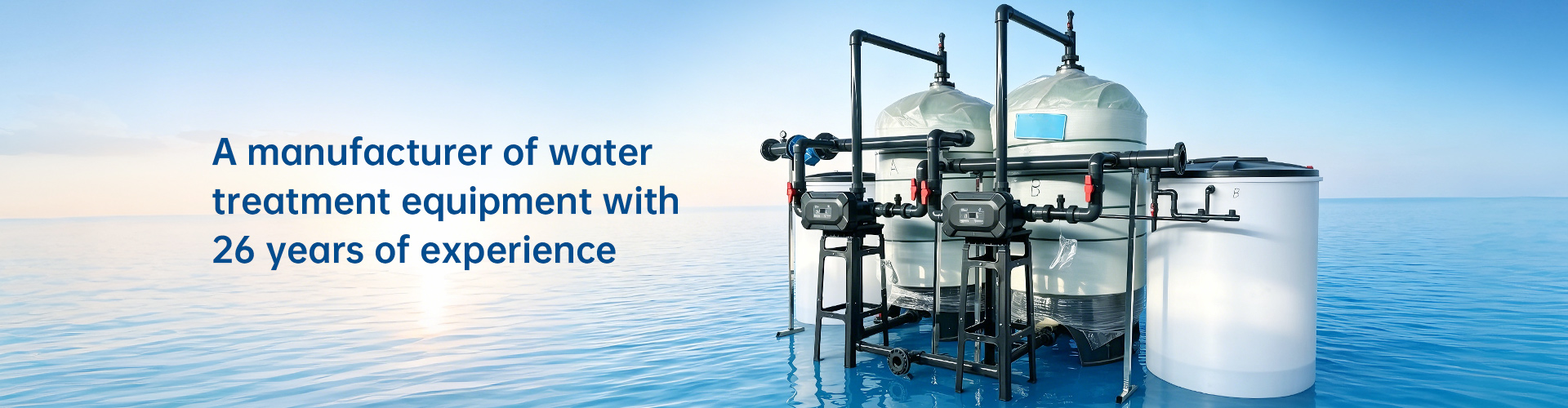
The pretreatment system for industrial water supply treatment involves multiple processes. Generally, electrodialysis, reverse osmosis, ion exchange and other treatment processes are taken as the main processes. To ensure the safe and economical operation of these main processes, the raw water needs to be treated to the influent water quality indicators allowed by these water treatment devices. In engineering, we often refer to the water purification, pre-softening or water quality adjustment before entering the main process as water quality pretreatment, or simply pretreatment. The main target of pretreatment is mechanical impurities......
Pretreatment system
Industrial water supply treatment involves multiple processes. Generally, electrodialysis, reverse osmosis, ion exchange and other treatment processes are the main ones. To ensure the safe and economical operation of these main processes, the raw water needs to be treated to the influent water quality indicators allowed by these water treatment devices. In engineering, we often refer to the water purification, pre-softening or water quality adjustment before entering the main process as water quality pretreatment, or simply pretreatment. The main targets of pretreatment are mechanical impurities, colloids, silica, microorganisms, organic matter and residual chlorine, etc., which have adverse effects on the subsequent treatment facilities. The quality of pretreatment directly affects the technical and economic effects and long-term operation of major treatment processes such as electrodialysis, reverse osmosis, and ion exchange. It is a very important part of industrial water supply treatment. In this plan, the term "influent" used in the following text refers to the influent that meets the water quality requirements of the subsequent water treatment device. At the same time, the changes in water quality and its components caused by pretreatment and the resulting impacts are also taken into account.
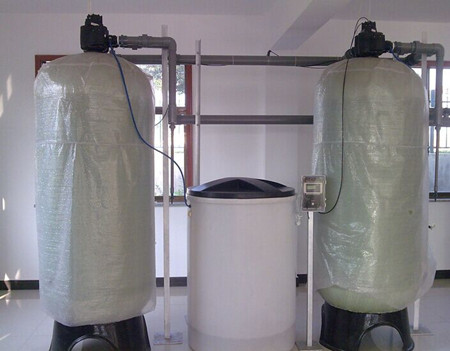
This scheme designs a pretreatment system composed of dosing devices, water supply pumps, activated carbon filters and other equipment. According to the relevant requirements of water supply and drainage design, the total water inflow required for this system is50.0m3/h. To address the contamination of suspended solids and colloids that make reverse osmosis membranes particularly sensitive and ensure the turbidity of the reverse osmosis feed water≤1.0NTU,Adopt oneΦ2600mmThe mechanical filter, with the flow rate controlled at8-10m/hLeft and right, the normal output of this equipment48.0m3/hIt can effectively remove most suspended solids, colloids and granular mechanical impurities in water, ensuringROThe pollution index of the system's influent(SDI)≤4. Under normal circumstances, when the pressure difference between the inlet and outlet reaches a certain value orSDIGreater than4when,It indicates that the filter material is contaminated. The operation of the equipment must be stopped and backwashing carried out. This equipment is designed to use air-water scrubbing for backwashing, with external compressed air as the air source. Backwashing can effectively remove sediment, suspended solids and other substances from the filter layer and prevent the filter material from caking, thus fully restoring its dirt-holding capacity. Adopt oneΦ2600mmThe flow rate of the activated carbon filter is controlled at8-10m/hLeft and right, the normal output of this equipment48.0m3/hIt can effectively adsorb organic matter and residues in tap waterCl2Reduce harmful substancesCODContent to prevent residual chlorine from oxidizing the composite film.
The function of the scale inhibitor dosing unit is to add a dedicated scale inhibitor of a certain rate before the pre-treated raw water enters reverse osmosis, in order to prevent scaling on the concentrated water side of reverse osmosis. The working process of reverse osmosis is that the raw water flows from one end to the other on one side of the membrane. Water molecules pass through the membrane surface and reach the other side from the raw water side, while inorganic salt ions are retained on the original side. As the flow of the raw water gradually increases, water molecules are constantly removed from the raw water, and the salt content remaining in the raw water gradually increases. That is, the raw water is gradually concentrated and eventually becomes concentrated water, which is discharged from the device. The concentration of various ions in concentrated water will increase several times after it is concentrated. In natural water sourcesCa2+,Mg2+,Ba2+,Sr2+,HCO3-,SO42-,SiO2The concentration products of ions that tend to form scale are generally less than their equilibrium constants, so no scale will occur. However, after concentration, the concentration products of various ions may far exceed the equilibrium constants, thus causing severe scaling.
The criteria for judging water scaling are:
a)For carbonate scale, the Langley index is used(LSI)As the benchmark: whenLSIOWhen scaling;
b)For sulfate scale, it is determined by the saturation index. The ratio of the concentration product of cations and anions in water to the saturation equilibrium constant is the saturation index.
When the saturation index is less than1When not, scale will form; conversely, scale will form.
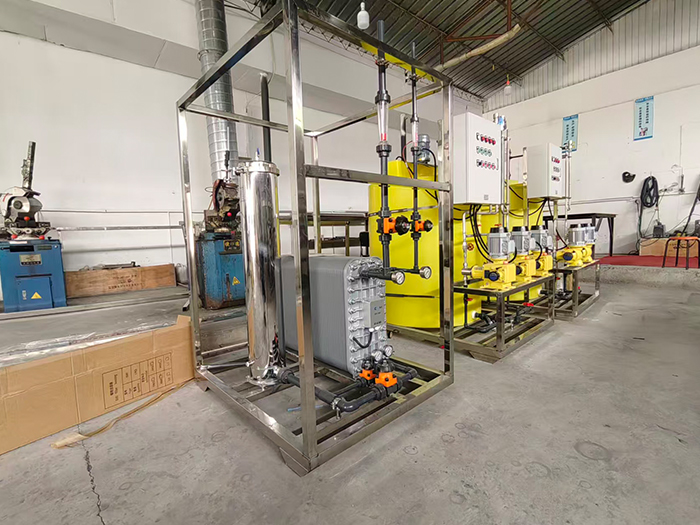
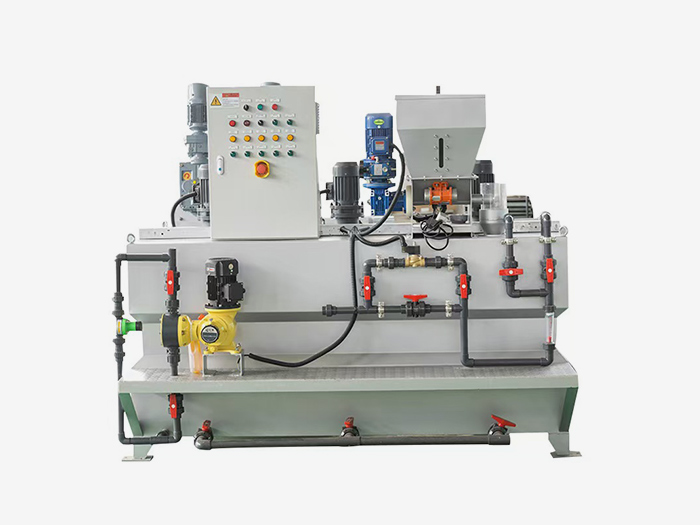
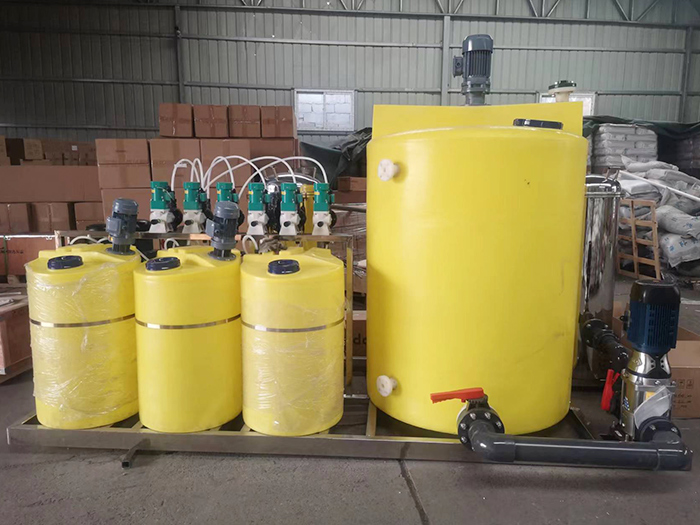
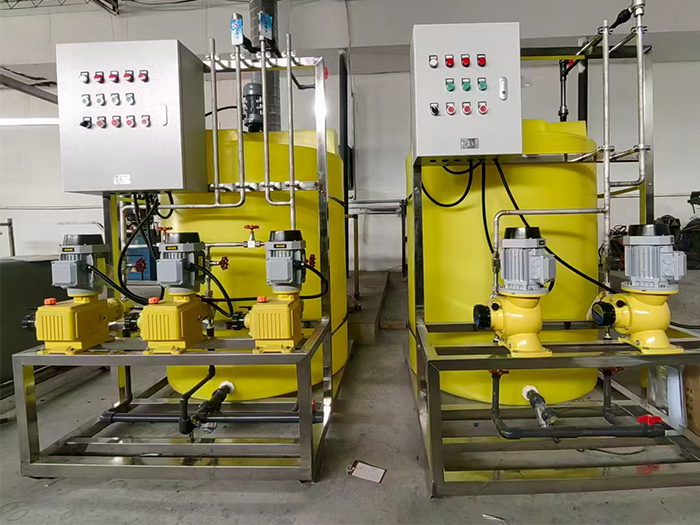
The dosage of the scale inhibitor used in this system design is approximately3-4mg/L. It can increase the saturation of insoluble salts in water and effectively prevent scaling on the concentrated water side of reverse osmosis. This part is composed of a dedicated dosing tank, imported electromagnetic diaphragm metering pumps and connecting pipelines. Among them, the dosing tank is importedPERaw materials, rotational molding in one step. It is smooth both inside and out, does not leak, does not grow moss or scale, and is easy to clean inside the bucket. It has good hygiene and corrosion resistance.
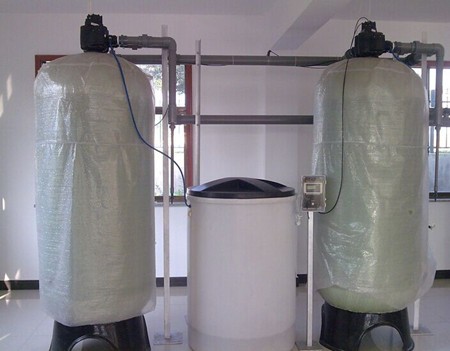
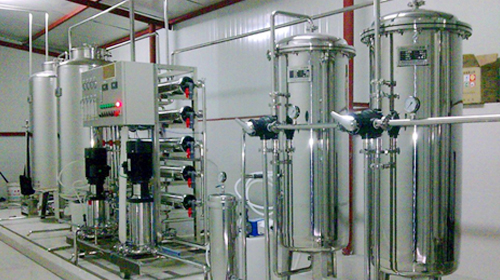
The requirements for water quality in industrial production are getting higher and higher. Ordinary tap water or well water contains impurities such as sediment, suspended solids, calcium and magnesium ions, heavy metals, and organic matter. Direct use will cause equipment scaling and corrosion, unstable product quality, increased energy consumption, and higher failure rates. Therefore, reverse osmosis pure water equipment has become an ideal choice for modern industrial water treatment.











 Landline:+86 010 59792055
Landline:+86 010 63780188
 Mobile:+86 13910114728
 Email:bjyuanlai@163.com
 Email:Wanda Plaza, Fengke Road, Fengtai District, BeijingBseat6Courtyard No.3Building No.7layer708
Yuanlai Homepage Softened water equipment Reverse osmosis pure water equipment Water supply equipment Engineering case Technical service Enter Yuanlai Site map
Softened water equipment Reverse osmosis pure water equipment Water purification equipment Water supply equipment Automatic dosing equipment High-purity water (ultra-pure water) equipment Wholesale of water treatment accessories
Electric power industry Petrochemical industry The electronic semiconductor industry The photovoltaic new energy industry Pharmaceuticals & Biochemical Engineering School research units Food and beverage industry Enterprises and public institutions
Reverse osmosis membrane Star-counting pump Fleck Valve Runxin Valve Instruments and meters Ultrafiltration membrane Softening resin Resin tank
Telephone consultation
"Online message
Wechat consultation