Bookmark this site Online message 中文站Welcome to the official website of Beijing Yuanlai Water Treatment Equipment Co., LTD.!
Service Hotline
+86 010 59792055 / +86 13910114728

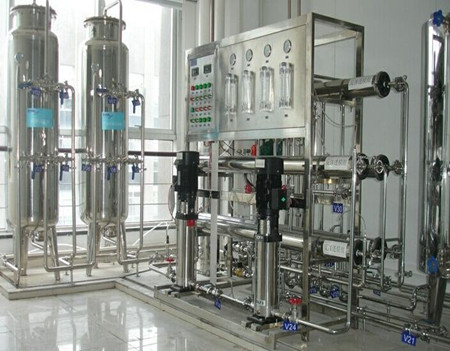
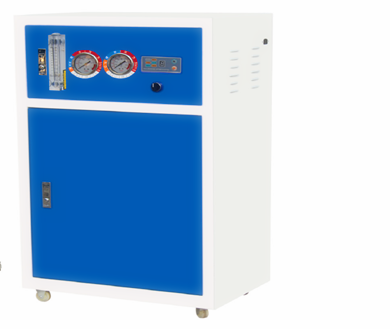
This equipment features a stainless steel frame, with an attractive appearance, convenient operation, and a reasonable design. The main core components are all made of imported materials, and the control part adoptsPLCControl, fully automatic production of high-purity water, one-click operation, simple and convenient to use, fully automatic flushing, no need for maintenance like traditional equipment. Users only need to take water for use, no need for complicated maintenance. Truly achieving fully automatic high-purity water production, deionized water equipment comes in small, medium and large sizes. Users can also customize it according to water consumption or water purity. The purity of the water produced by the deionized water equipment is as follows: Laboratory Grade one standard; Secondary standards, tertiary standards; Grade 1 pure water standard: Online resistivity18.25Megohm centimeters Grade two pure water standard: The online resistivity is greater than10Megohm centimeters Grade 3 pure water standard: The online conductivity is less than10us/cm.
Application scope in the electronics and circuit industries: Ultra-pure water for the production of electronic components, integrated circuits, semiconductor materials, liquid crystal displays, etc. Process flow: Raw water→Raw water tank→Raw water pump→Mechanical filter→Activated carbon filter→Scale inhibition/Softening device→Security filter→High-pressure pump→Reverse osmosis→Pure water tank→Transfer pump→Mixed bed/EDI→Ultraviolet removalTOC→Ultra-purification→"Ultraviolet"→Terminal filtering→Water usage point→The water quality of the circulating pure water tank: National standard for electronic-grade ultrapure waterGB/T11446.1-1997Process description:
1Mechanical filters are mainly used to remove impurities such as rust, sediment, algae and suspended solids from water, reduce water turbidity and make the turbidity of the effluent less than0.5NTU,CODMNLess than1.5mg/LThe iron content is less than0.05mg/L,SDI≤5.Backwashing and forward washing can be carried out at any time through the control valve to wash away the dirt on its surface, prevent clogging and restore its filtering capacity.
2Activated carbon filters have extremely strong adsorption and filtration performance, and can effectively adsorb residual chlorine, discoloration, odor, organic matter and other substances in water. As reverse osmosis membranes are highly sensitive to residual chlorine and organic matter, activated carbon is configured to adsorb residual chlorine and organic matter, ensuring that the effluent contains residual chlorine≤0.1mg/L,SDI≤4Meet the feed water requirements of reverse osmosis membranes. Backwashing can be carried out at any time by controlling the valve to wash away the dirt on its surface, prevent clogging and restore its processing capacity.
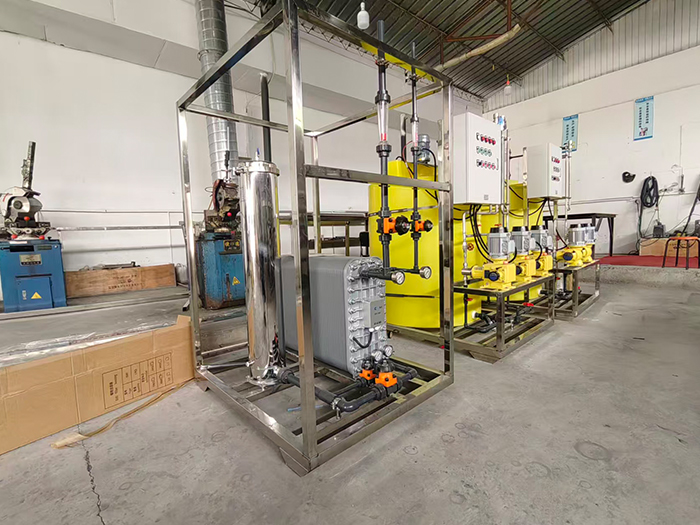
3Scale inhibition device (softener) severalmg/LThe scale inhibitor can prevent hundredsmg/LCalcium carbonate precipitates out. The mechanism of action is that the long-chain anions generated by the scale inhibitor in water are prone to adsorb onto the tiny calcium carbonate grains, and at the same time, these anions are easy to react withCO32-The ion replacement occurs on the entire calcium ion layer dispersed in water, thereby preventing the precipitation of calcium carbonate. It adopts the American Mitonro metering pump for automatic dosing, ensuring accurate metering and reliable dosing. The dosage of the medicine is approximately3PPM.At present, scale inhibition devices are mostly used in pure water systems because they are more reliable than softeners and have lower operating costs.
4After pretreatment, a security filter is installed before the high-pressure pump to prevent impurity particles from entering the high-pressure pump and damaging the high-pressure pump and reverse osmosis membrane. Adopt the type that is loose on the outside and tight on the insidePPThe filter element (with a frame and good strength) filters water from the outside to the inside, which can extend the time when the filter element is clogged. The upper part is equipped with an exhaust valve, which can prevent air from entering the pump and damaging it. The lower part is equipped with a drain valve, which can discharge the retained impurities at any time.
5Reverse osmosis technology is currently a very mature desalination technology and also a widely used water treatment process with a broad range of applications in the market. It can precisely filter out viruses, metal ions, salts and various carcinogens in water. It features low working pressure, large water production, high desalination rate and is easy to maintain. Designing an automatic flushing device can extend its service life.
6Mixed bed deviceEDIThe device is a uniform mixture of strong acid type cation resin and strong base type anion resin in a certain proportion, which is used to remove the residual anions and cations in water, and the resin is exchanged offH+,OH-Quickly combine to form water, achieving the purpose of purifying water. When it fails, it can be processed through the configured regeneration device and then its exchange capacity can be restored. Now the new process is adoptedEDIThere are quite a few devices.EDIContinuous electro-deionization can replace mixed beds to produce ultrapure water. This technology does not require acid and alkali regeneration, but the one-time cost is relatively high.
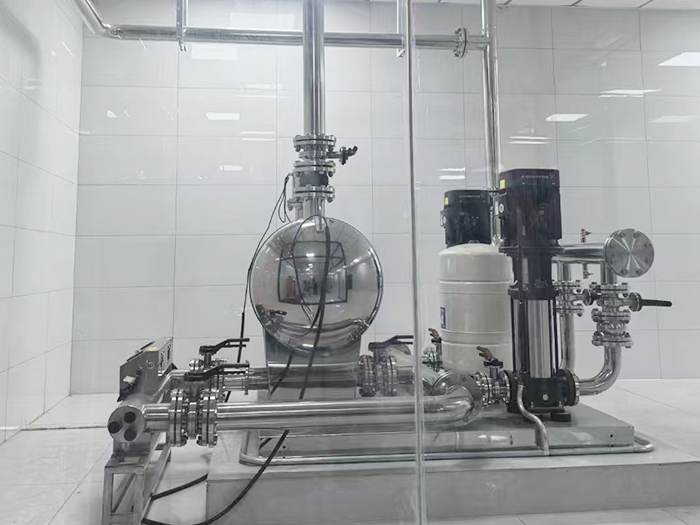
7Ultraviolet removalTOC "Adopt185nmUltraviolet rays of different wavelengths oxidize organic compounds in pure water, thereby reducing the total organic carbon concentration in pure water to an extremely low level.
8The ultra-purification device adopts a special ion polishing technology to remove the residual anions and cations in water, thereby making the resistance of the effluent water reach18.25MΩ·CMThat's all.
9The ultraviolet device adopts254nmLong ultraviolet rays have a long lifespan, good effect, low power consumption, do not pollute water quality, leave no residue, and are easy to install in pipelines. It is currently the most effective method.
10The terminal filter adopts microporous filter membranes with corresponding pore sizes as needed to remove microorganisms and particles, ensuring that the feed water is sterile and free of particles, meeting the requirements for electronic water use.
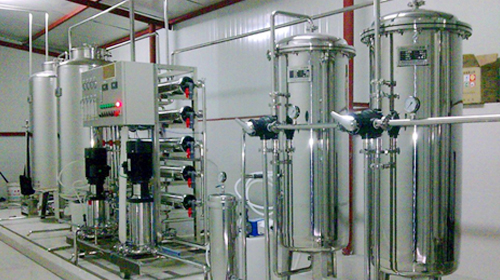
The requirements for water quality in industrial production are getting higher and higher. Ordinary tap water or well water contains impurities such as sediment, suspended solids, calcium and magnesium ions, heavy metals, and organic matter. Direct use will cause equipment scaling and corrosion, unstable product quality, increased energy consumption, and higher failure rates. Therefore, reverse osmosis pure water equipment has become an ideal choice for modern industrial water treatment.











 Landline:+86 010 59792055
Landline:+86 010 63780188
 Mobile:+86 13910114728
 Email:bjyuanlai@163.com
 Email:Wanda Plaza, Fengke Road, Fengtai District, BeijingBseat6Courtyard No.3Building No.7layer708
Yuanlai Homepage Softened water equipment Reverse osmosis pure water equipment Water supply equipment Engineering case Technical service Enter Yuanlai Site map
Softened water equipment Reverse osmosis pure water equipment Water purification equipment Water supply equipment Automatic dosing equipment High-purity water (ultra-pure water) equipment Wholesale of water treatment accessories
Electric power industry Petrochemical industry The electronic semiconductor industry The photovoltaic new energy industry Pharmaceuticals & Biochemical Engineering School research units Food and beverage industry Enterprises and public institutions
Reverse osmosis membrane Star-counting pump Fleck Valve Runxin Valve Instruments and meters Ultrafiltration membrane Softening resin Resin tank
Telephone consultation
"Online message
Wechat consultation