Bookmark this site Online message 中文站Welcome to the official website of Beijing Yuanlai Water Treatment Equipment Co., LTD.!
Service Hotline
+86 010 59792055 / +86 13910114728

Product Description
Introduction to the Principle and Technology of Groundwater Iron and Manganese Removal Devices 1The principle of iron and manganese removal from groundwater
Because the properties of iron and manganese are very similar, the principle of removing iron and manganese is also the same, that is: use the oxidation method to fully aerate and remove the dissolved substances in the water+2Iron and manganese oxidize to form+3"Valent iron and+4The iron and manganese precipitates formed by the oxidation and flocculation of insoluble compounds can be removed by filtration, thereby achieving the effect of iron and manganese removal.
2Traditional groundwater iron and manganese removal technologies
For a long time, people have been using physical and chemical methods to remove divalent iron and divalent manganese from water. The United States1950Manganese-rich green sand was effectively applied to the iron and manganese removal processes in that year.
2.1Aeration oxidation method
This method utilizes the oxygen in the air and that in water+2When iron comes into contact with manganese, it oxidizes to+3"Valent iron and+4The compounds containing manganese are then precipitated and filtered to achieve the purpose of removing iron and manganese. This process removes the iron and manganese requiredPHThe value should not be lower than7.0,PHThe higher the value, the faster the oxidation rate. The purpose of aerating water is not only to provide sufficient oxygen but also to remove impurities from the waterCO2To improve the waterPH.
2.2Aeration contact oxidation method
After aeration, water containing dissolved oxygen passes through active filter media containing iron and manganese. Under the catalytic effect of the iron and manganese dioxide they contain, the oxidation rate of divalent iron and manganese is greatly accelerated, and they are then removed by the active filter media. Among them, the active filter material can be natural manganese sand or formed by the maturation of ordinary sand filter material. Required for the contact oxidation methodPHThe value is not less than6.0It is generally greater than7.0. The purpose of aeration in this process is to provide sufficient oxygen to the water.
3The performance of modified filter materials
Modified filter media are produced by coating metal oxides or hydroxides on the surface of carriers (such as common quartz sand filter media, ceramsite filter media or some natural materials with large surface areas). Under the presence of water molecules, the surface of metal oxides has a large number of hydroxyl groups. The hydroxylated surface can undergo ion exchange reactions with metal ions in water. This changes the physical and chemical properties of the surface of the original filter material particles to enhance the filter material's dirt-holding capacity. Even in a neutral environment, it can enhance the adsorption capacity of the filter material for iron and manganese. Compared with traditional filter materials, modified filter materials have more surface adsorption sites. Therefore, they have more obvious advantages in iron and manganese removal than natural manganese sand or quartz sand. To enhance the adhesion of the surface molecular structure of the filter material particles, a chemical film with a relatively high van der Waals force constant is formed on the surface of the filter material. The larger the molecular weight of the compounds contained in the film, the stronger its adsorption capacity for particles.
Based on a large number of experimental studies, it is found that the filtration effect of modified filter materials is mainly reflected in the following aspects:
(1Remove suspended impurities from water. Gao Naiyun and others from Tongji University conducted an experimental study on the enhanced filtration treatment of slightly polluted water using alumina-modified quartz sand as the filter material. The results showed that the surface of the quartz sand after treatment had zero chargePHThe value is0.7-2.2Raise to7.5-9.5. Therefore, even for slightly polluted raw water, when treated with modified quartz sand, the purpose of reducing turbidity can be achieved without adding any coagulant. Moreover, suspended impurities and trace dissolved organic matter in the raw water have also been removed to varying degrees.
(2Adsorb heavy metal ions in water, such asPb2+,Cd2+,Cu2+,Ni2+,Cr2+For instance, the main removal mechanisms are chemical adsorption, ion exchange adsorption and ion precipitation.
(3Remove arsenic from water.MattewL.PierceSome people used amorphous ferric hydroxide to adsorb substances in waterAs(Ⅲ"And"As(ⅤThe results show that the ratio of adsorbent to arsenic concentration is appropriate and properPHUnder these conditions, the removal rate of arsenic can be achieved92%.
(4Remove selenium from water. Using sand grains covered with alumina as adsorbents can effectively remove substances from waterSe(Ⅵ"And"Se(Ⅳ" At an appropriate timePHUnder the conditions of value, adsorption dosage and adsorption time,SeThe removal rate can reach nearly100%.
(5The removal of microorganisms in water mainly utilizes the electrical properties on the surface of the filter material to enhance electrostatic adsorption or reduce electrostatic repulsion.
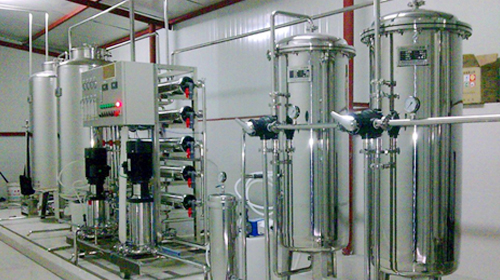
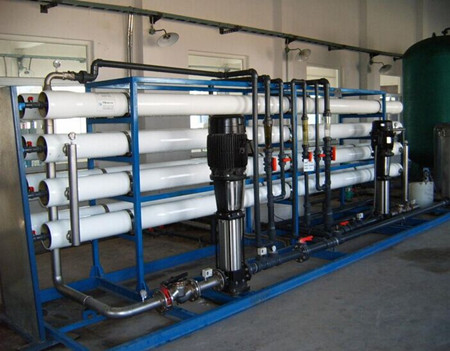
The requirements for water quality in industrial production are getting higher and higher. Ordinary tap water or well water contains impurities such as sediment, suspended solids, calcium and magnesium ions, heavy metals, and organic matter. Direct use will cause equipment scaling and corrosion, unstable product quality, increased energy consumption, and higher failure rates. Therefore, reverse osmosis pure water equipment has become an ideal choice for modern industrial water treatment.











 Landline:+86 010 59792055
Landline:+86 010 63780188
 Mobile:+86 13910114728
 Email:bjyuanlai@163.com
 Email:Wanda Plaza, Fengke Road, Fengtai District, BeijingBseat6Courtyard No.3Building No.7layer708
Yuanlai Homepage Softened water equipment Reverse osmosis pure water equipment Water supply equipment Engineering case Technical service Enter Yuanlai Site map
Softened water equipment Reverse osmosis pure water equipment Water purification equipment Water supply equipment Automatic dosing equipment High-purity water (ultra-pure water) equipment Wholesale of water treatment accessories
Electric power industry Petrochemical industry The electronic semiconductor industry The photovoltaic new energy industry Pharmaceuticals & Biochemical Engineering School research units Food and beverage industry Enterprises and public institutions
Reverse osmosis membrane Star-counting pump Fleck Valve Runxin Valve Instruments and meters Ultrafiltration membrane Softening resin Resin tank
Telephone consultation
"Online message
Wechat consultation