Bookmark this site Online message 中文站Welcome to the official website of Beijing Yuanlai Water Treatment Equipment Co., LTD.!
Service Hotline
+86 010 59792055 / +86 13910114728

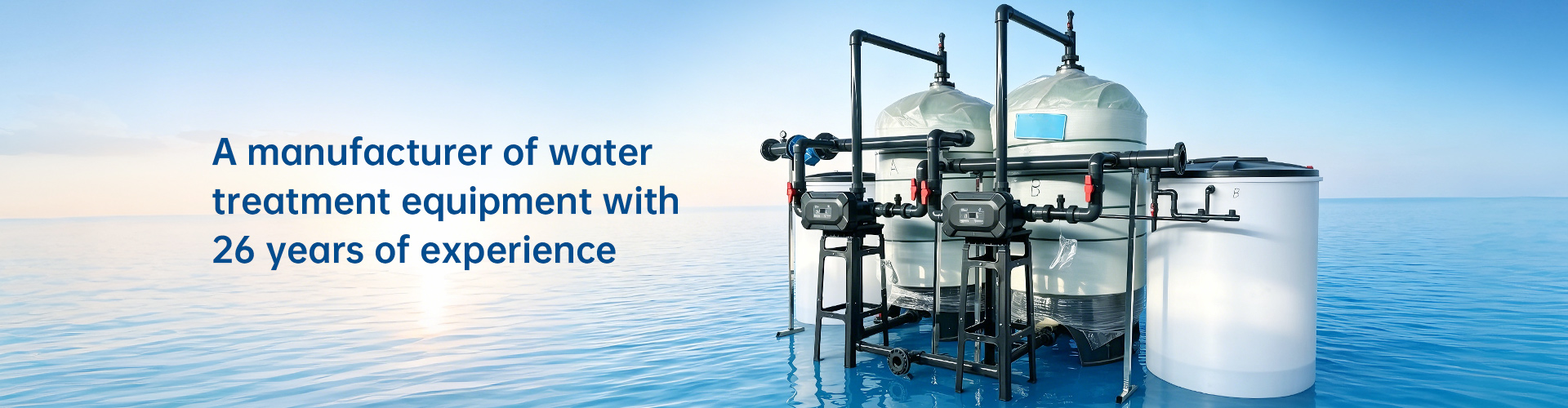
Working principle: When the raw water containing hardness ions passes through the resin layer inside the exchanger, the ions in the waterCa2+,Mg2+It then undergoes displacement with the sodium ions adsorbed by the resin, and the resin is adsorbedCa2+,Mg2+whileNa+When it enters the water, the water flowing out of the exchanger is softened water with its hardness removed. Since the hardness of water is mainly formed and represented by calcium and magnesium, cation exchange resin (water softener) is generally used to remove the hardness of waterCa2+,Mg2+Replacement (the main component that forms scale)......
Working principle
When the raw water containing hardness ions passes through the resin layer in the exchanger, the ions in the waterCa2+,Mg2+It is adsorbed by the resin Sodium ions undergo displacement and are adsorbed by the resinCa2+,Mg2+whileNa+When it enters the water, the water flowing out of the exchanger is softened water with its hardness removed.
Since the hardness of water is mainly formed and represented by calcium and magnesium, cation exchange resin (water softener) is generally used to remove the hardness of waterCa2+,Mg2+The main components that form scale are displaced and carried out within the resinCa2+,Mg2+The increase, resin removalCa2+,Mg2+Its efficiency gradually decreases.
When the resin absorbs a certain amountCa2+,Mg2+After that, regeneration is carried out. The regeneration process involves using a single valve and single tank in a water softening device.
The brine in the salt tank flushes the resin layer, displacing the hardness ions on the resin and discharging them out of the tank with the regeneration waste liquid. Thus, the resin regains its softening exchange function.
The hardness of water is mainly formed and represented by calcium and magnesium. The principle of sodium ion exchange softening treatment is to pass the raw water through sodium-type cation exchange resin to reduce the hardness components in the waterCa2+,Mg2+In the resinNa+Exchange with each other, thereby adsorbing substances in waterCa2+,Mg2+Soften the water. As followsRNaRepresenting sodium-type resin, its exchange process is as follows:
2RNa + Ca2+ = R2Ca + 2Na+
2RNa + Mg2+ = R2Mg + 2Na+
That is, after water passes through the sodium ion exchanger, in the waterCa2+,Mg2+Be replacedNa+.
Workflow
The process consists of five steps: working (sometimes called water production, the same below), backwashing, salt absorption (regeneration), slow rinsing (replacement), and fast rinsing. All the processes of different water softening equipment are very similar. However, due to the differences in actual processes or control requirements, there may be some additional procedures. AnyNa+All exchange-based water softening equipment is developed on the basis of these five processes (among which, fully automatic water softening equipment will add a brine recharging process).
Backwashing: After the equipment has been in operation for a period of time, a lot of impurities brought by the raw water will be intercepted on the upper part of the resin. Only after removing these impurities can the ion exchange resin be exposed and the regeneration effect be guaranteed. The backwashing process involves water being washed in from the bottom of the resin and flowing out from the top, which can wash away the dirt trapped at the top. This process usually requires5-15About a minute.
Salt absorption (regeneration) : This is the process of injecting brine into the resin tank. Traditional equipment uses a salt pump to inject brine, while fully automatic equipment uses a dedicated built-in injector to draw in brine (as long as there is a certain pressure in the incoming water). In the actual working process, the regeneration effect of salt water flowing slowly through the resin is better than that of simply soaking the resin in salt water. Therefore, water softening equipment all adopt the method of salt water flowing slowly through the resin for regeneration. This process generally requires30It takes about minutes, but the actual time is affected by the amount of salt used.
Slow rinsing (displacement) : After the salt water flows through the resin, the process of slowly rinsing all the salt in the resin with the original water at the same flow rate is called slow rinsing. This is because there are still a large amount of calcium and magnesium on the functional groups during this rinsing process Ions are exchanged with sodium ions. Based on practical experience, this process is the main part of regeneration, so many people refer to it as displacement. This process usually takes the same amount of time as salt absorption, that is30About a minute.
Quick rinse: To thoroughly wash away the remaining salt, the resin should be rinsed with raw water at a flow rate close to the actual working condition. The effluent from this process should be qualified soft water. Under normal circumstances, the quick rinse process is5-15Minutes.
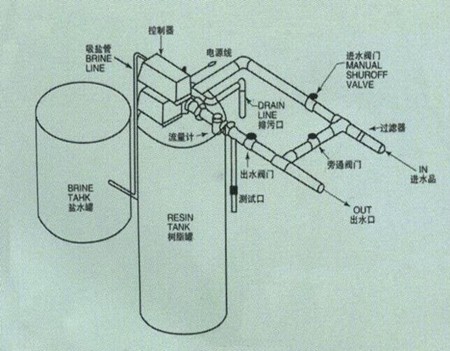
Schematic diagram of the working process of the water softening equipment
Job requirements
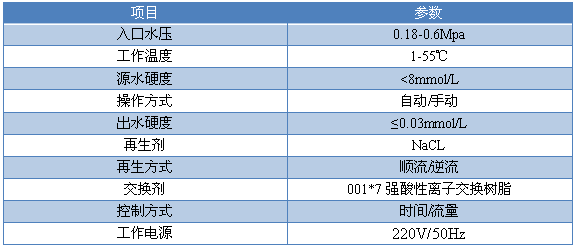
Controller type
Manual type
This approach is the traditional standard method, mainly including the downstream flow/There are two forms of countercurrent without top pressure. Generally, two carbon steel structure tanks are connected in parallel. Depending on the different process flows, each tank needs to be matched8-11Only manual valves are required (two tanks need to be equipped)16-20When regenerating, a dedicated salt pump is used to pump the dissolved salt solution into the resin tank (this type of equipment was once the main form of water softening equipment in China). The main features of this type of water softening equipment structure are: the process is simple and easy to understand, easy to operate, low cost, and can be applied to the need of large flow. However, the technology is backward, it occupies a large area, consumes a lot of energy during operation, has a relatively high intensity in actual operation, causes severe corrosion of the salt pump and has a high maintenance cost.
Domestic combined automatic type
Due to the overly complex use of manual equipment, in20Century90In the early years of the 1980s, a new type of equipment with a combined integrated valve as its core emerged in China. The main core component of this equipment is a multi-channel integrated valve, which changes the direction of water flow by rotating the valve body. Compared with traditional manual equipment, this kind of equipment takes up much less space and has a higher degree of automation. However, due to the use of time control in the control mode, the control accuracy during operation is relatively low. Due to the limitations of design concepts, processing techniques and materials, the planar integrated valves adopted by most equipment are prone to wear and tear, and the possibility of wear once they occur is very small. There are many manufacturers of this kind of equipment in the domestic market, and the actual quality of the products varies greatly. The operation effect of many devices is not satisfactory.
Imported fully automatic type
In European and American countries, since20Century60Since the 1980s, the automation design of ion exchange equipment has been carried out. With the development of industrial technology, multi-way valves and integrated valves, which are different from domestic multi-way valves, have gradually emerged. The main type is multi-way valves, and the main materials are engineering plastics and lead-free brass. Its core component is a multi-channel integrated valve, which generally uses a valve plate or piston to control the direction of water flow and is driven by a small motor to operate the camshaft (or piston). Due to the relatively advanced industrial technology level abroad, this type of equipment has developed quite well, and the product specifications range from household ones0.2t/hFor industrial use70t/hBoth left and right are available, and the controller has a high degree of automation (the new one can already communicate with industrial computers or ordinary monitoring computers).
Discrete valve fully automatic type
Discrete valves are generally imported fully automatic diaphragm valves or solenoid valves, and they adopt a structure similar to the traditional manual method.
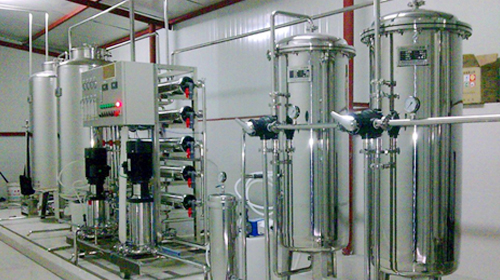
The requirements for water quality in industrial production are getting higher and higher. Ordinary tap water or well water contains impurities such as sediment, suspended solids, calcium and magnesium ions, heavy metals, and organic matter. Direct use will cause equipment scaling and corrosion, unstable product quality, increased energy consumption, and higher failure rates. Therefore, reverse osmosis pure water equipment has become an ideal choice for modern industrial water treatment.











 Landline:+86 010 59792055
Landline:+86 010 63780188
 Mobile:+86 13910114728
 Email:bjyuanlai@163.com
 Email:Wanda Plaza, Fengke Road, Fengtai District, BeijingBseat6Courtyard No.3Building No.7layer708
Yuanlai Homepage Softened water equipment Reverse osmosis pure water equipment Water supply equipment Engineering case Technical service Enter Yuanlai Site map
Softened water equipment Reverse osmosis pure water equipment Water purification equipment Water supply equipment Automatic dosing equipment High-purity water (ultra-pure water) equipment Wholesale of water treatment accessories
Electric power industry Petrochemical industry The electronic semiconductor industry The photovoltaic new energy industry Pharmaceuticals & Biochemical Engineering School research units Food and beverage industry Enterprises and public institutions
Reverse osmosis membrane Star-counting pump Fleck Valve Runxin Valve Instruments and meters Ultrafiltration membrane Softening resin Resin tank
Telephone consultation
"Online message
Wechat consultation