Bookmark this site Online message 中文站Welcome to the official website of Beijing Yuanlai Water Treatment Equipment Co., LTD.!
Service Hotline
+86 010 59792055 / +86 13910114728

In daily life, we often see that scale forms on the inner walls of kettles after long-term use. What's the reason for this?It turns out that the water we took contains a considerable amount of inorganic salt substances, such as calcium and magnesium salts. These salts cannot be detected by the naked eye in water at normal temperature. Once they are heated and boiled, a considerable amount of calcium and magnesium salts will precipitate in the form of carbonates. When they adhere to the inner walls of the kettle, they form scale. We usually express the content of calcium and magnesium ions in water by the indicator of "hardness". Hardness1Degree is equivalent to the amount contained in each liter of water10Milligram calcium oxide. Lower than8Water at a certain degree is called soft water, which is higher than17Water of a certain degree is called hard water, which is between8~17Water of varying degrees is called moderately hard water. Rain, snow water, river water, lake water are all soft water, while spring water, deep well water and sea water are all hard water.
The essential difference between softened water and other types of water
Raw water refers to water that has not undergone treatment. In a broad sense, the water that enters the water treatment process before it is also called the raw water for that water treatment. For example, water sent from a water source to a clarifier for treatment is called raw water.
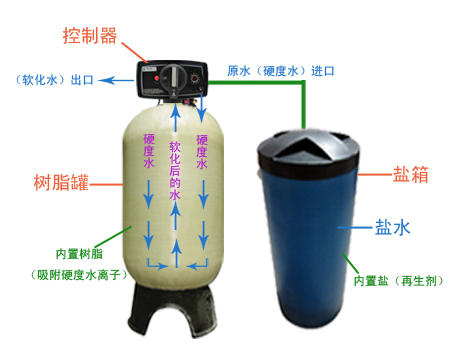
Softened water refers to the hardness in water(It mainly refers to calcium and magnesium ions in water)Remove or reduce a certain degree of water. During the process of water softening, only its hardness decreases, while the total salt content remains unchanged.
Demineralized water refers to the salts in water(It is mainly a strong electrolyte dissolved in water)Water removed or reduced to a certain extent. Its electrical conductivity is generally1.0~10.0μS/cmResistivity(25℃)(0.1~1.0)×106Ω˙cmThe salt content is1~5mg/L.
Pure water refers to the strong and weak electrolytes in water(Such asSiO2,CO2Such as)Remove or reduce water to a certain extent. Its electrical conductivity is generally:1.0~0.1μS/cmElectrical conductivity(1.01.0~10.0)×106Ω˙cm. The salt content is<1mg/L.
Ultra-pure water refers to water in which almost all conductive media have been removed, while gases, colloids and organic substances do not dissociate(Including, etc)It also removes a very low level of water. Its electrical conductivity is generally0.1~0.055μS/cmResistivity(25℃)﹥10×106Ω˙cmSalt content﹤0.1mg/L. Ideal pure water(Theoretically)The electrical conductivity is0.05μS/cmResistivity(25℃)for18.3×106Ω˙cm.
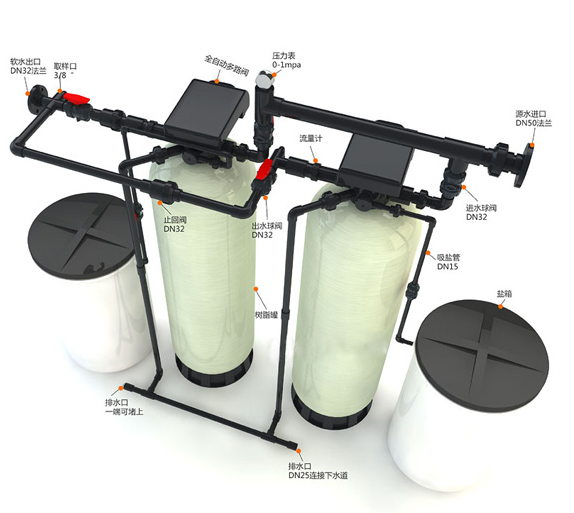
I. Installation Requirements for Fully Automatic Water Softener:
1The water tank should be installed on a solid cement platform, and a drainage ditch should be provided nearby.
2The salt tank should be placed close to the resin tank and the length of the salt suction pipe should be shortened as much as possible.
3The ambient temperature must not be lower than2℃Or higher50℃;
4When the water softener is directly connected to the heating equipment, it should be maintained3For pipe sections over a meter long, check valves should be installed.
5It should be convenient for the replenishment of regenerant.
6There should be space for operation and maintenance near the equipment.
Ii. Installation of control valves and filling of resin in tanks
aBefore filling, the lifting pipe (with the lower water distributor) should be placed in the resin tank below the tank opening0.5mmAt this point, cut off and guide the Angle (at this time, the lifting pipe opening should be sealed with tape to prevent resin from entering the lifting pipe).
bPour the resin into the resin tank along the gaps around the lifting pipe and make it level at the bottom of the tank.
cPour the processed resin into the resin tank along the periphery of the lifting pipe in accordance with the specified filling volume.
dThe above operations should keep the lifting pipe always at the position of the resin tank opening.
eRemove the sealing tape of the lifting pipe.
fAfter installing the water distributor, align the socket of the controller with the lifting pipe, and carefully turn the control valve clockwise. (Note: During the installation of the control valve, make sure the lifting pipe is inserted into the valve body.) Tighten the control valve onto the interface of the tank.
Iii. Pipeline Connection of Water Softening Equipment
1For the connection of roads, please refer to the relevant contents of the local construction standards.
2Connect the inlet and outlet water pipes according to the controller's diameter. The raw water supply pipeline shall not be smaller than the inlet pipe diameter to ensure sufficient flow.
3Manual valves should be installed on the inlet and outlet pipes. A bypass valve should be installed between the inlet and outlet pipes. A sampling valve should be installed in front of the outlet pipe section. It is recommended to install one on the inlet pipeYType filter; Prevent dirt in the pipeline from blocking the valve body and causing the equipment to fail to operate normally. When multiple systems are connected in parallel, pay attention to the same path of the inlet and outlet water pipelines.
4Try to shorten the connection length of the drainage pipe, reduce the degree of curvature, and the distance between the control valve and the drainage ditch should not exceed6"Mi;
5When connecting the drainage pipe to the drainage channel, keep a certain distance between the water surfaces of the drainage pipe and the drainage channel to prevent sewage from being siphoned back to the water softener.
6No valves of any kind shall be installed in the drainage pipes.
7The connection of the brine pipe must maintain good sealing; otherwise, it will affect the regeneration effect of the water softener.
8All kinds of pipelines are equipped with independent supports, and it is not allowed to transfer the gravity and stress of the pipelines to the control valves.
Iv. Selection and Application Scope of Water Softening Equipment
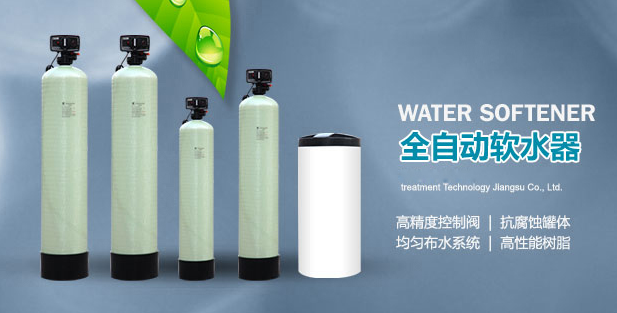
① Controllers: They are divided into automatic control and manual control. The choice of brand can be either imported or domestic.
② Resin tank: The tank body materials of the water softening device are divided into fiberglass reinforced plastic, carbon steel and stainless steel.
③ Equipment control form: One type is that when the prepared water volume reaches the set value, it automatically restores, which is called the flow type;It is applicable to all water supply system softening water treatment equipment. One type is a way of controlling regeneration metering based on time, which is called the time type;It is suitable for water supply systems with stable water volume, and the short restoration and regeneration cycle is24Hours.
④Equipment combination
Single control single bed: Water supply is stopped during the reduction period2For hours or continue to supply raw water(Hard water bypass).
Single-controlled dual-bed: Alternating water supply, one in use and one as backup. Dual-control dual-bed: Alternating water supply, one in use and one as backup.
Dual-control dual-bed: Simultaneous water supply and alternating regeneration.
Multiple control beds: Three or more softened water resin tanks can be used in parallel, which is suitable for large-scale water supply systems.
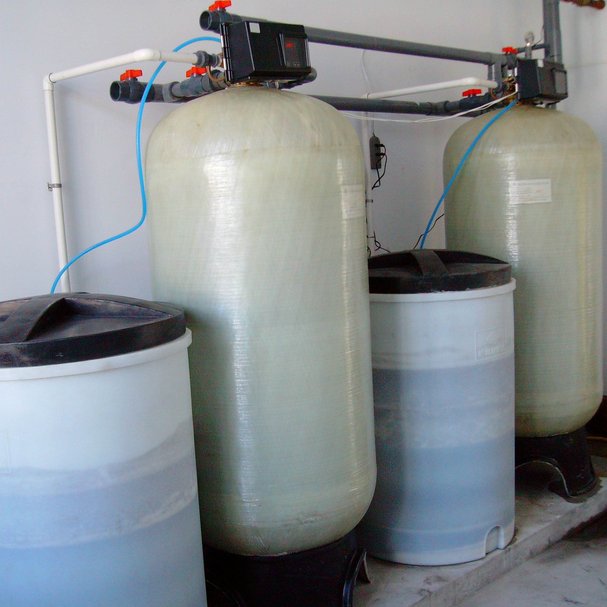
The water softening equipment (softener) provided by Beijing Yuanlai Water Treatment Company can be widely applied to the softening of make-up water for steam boilers, hot water boilers, exchangers, evaporative condensers, air conditioners, direct-fired machines and other systems. It can also be used for the treatment of domestic water in hotels, restaurants, office buildings, apartments, homes, etc., as well as for softening water treatment in industries such as beverages, brewing, laundry, printing and dyeing, chemical engineering, and medicine.
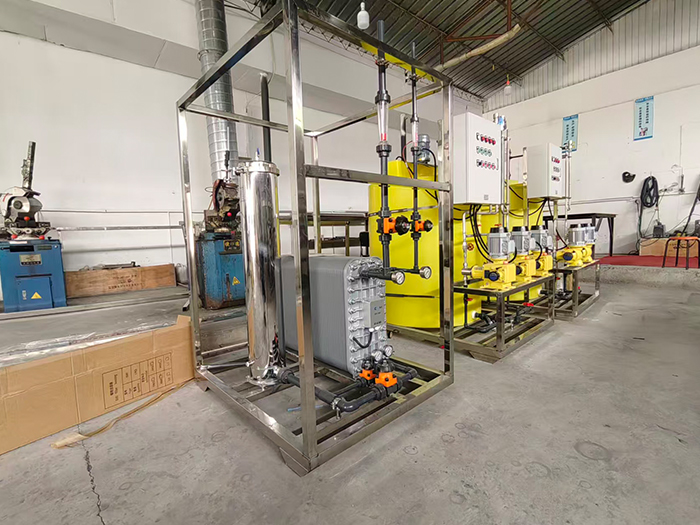
Yuan LaiEDIThe ultra-pure water equipment uses electro-deionization technology.EDIElectrodeionization is a water purification method that combines the dual advantages of electrodialysis and ion exchange. It does not require acid-base chemical regeneration and can continuously and stably prepare high-purity ultrapure water. Under the action of a direct current electric field, ion separation in water is completed. At the same time, water is electrolyzed to generate hydrogen ions and hydroxide ions, achieving automatic regeneration of the resin without the need to stop the machine for manual regeneration. The pre-treatment combined with reverse osmosis can prevent oxidized substances from damaging the resin, ensuring stable effluent quality and widely meeting the high-standard water usage requirements of various industries.
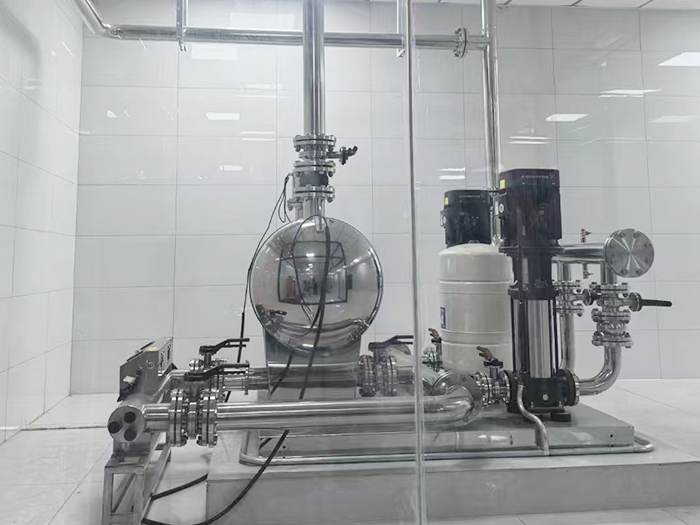
The non-negative pressure water supply equipment can be directly connected to the municipal water supply network, making full use of the residual pressure of the original network for superimposed water supply. Fully enclosed operation does not require the construction of a domestic water tank, eliminating secondary pollution. Intelligent variable frequency voltage stabilization, energy-saving, quiet and easy installation, it is the preferred equipment for secondary water supply in high-rise residential buildings and commercial buildings.
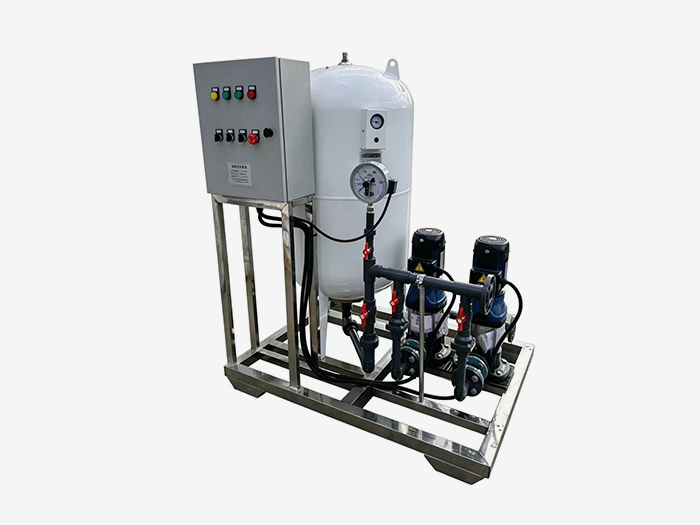
Constant pressure water supply equipment is widely used in central air conditioning, floor heating, industrial closed-loop water circulation, and boiler systems. It integrates automatic pressure stabilization, automatic water replenishment, automatic exhaust, pressure relief and buffering functions. It stabilizes the pressure in the pipeline network, eliminates abnormal sounds caused by air blockage, and prevents damage from negative pressure and water shortage in the pipeline. It is an essential supporting equipment for HVAC and circulating water systems.











 Landline:+86 010 59792055
Landline:+86 010 63780188
 Mobile:+86 13910114728
 Email:bjyuanlai@163.com
 Email:Wanda Plaza, Fengke Road, Fengtai District, BeijingBseat6Courtyard No.3Building No.7layer708
Yuanlai Homepage Softened water equipment Reverse osmosis pure water equipment Water supply equipment Engineering case Technical service Enter Yuanlai Site map
Softened water equipment Reverse osmosis pure water equipment Water purification equipment Water supply equipment Automatic dosing equipment High-purity water (ultra-pure water) equipment Wholesale of water treatment accessories
Electric power industry Petrochemical industry The electronic semiconductor industry The photovoltaic new energy industry Pharmaceuticals & Biochemical Engineering School research units Food and beverage industry Enterprises and public institutions
Reverse osmosis membrane Star-counting pump Fleck Valve Runxin Valve Instruments and meters Ultrafiltration membrane Softening resin Resin tank
