Bookmark this site Online message 中文站Welcome to the official website of Beijing Yuanlai Water Treatment Equipment Co., LTD.!
Service Hotline
+86 010 59792055 / +86 13910114728

Beijing Yuanlai Water Treatment Equipment Co., Ltd. provides (water quality standards for softened water equipment)
1 The resistance value of water
When determining the electrical conductivity of water, it is related to the size of the water's resistance value. A large resistance value indicates poor electrical conductivity, while a small resistance value suggests good electrical conductivity. According to Ohm's Law, the resistance value of water at a constant water temperatureRThe size is related to the vertical cross-sectional area of the electrodeFIt is inversely proportional to the distance between the electrodesLIt is directly proportional.
The magnitude of water's resistivity is related to the amount of salt in the water, the concentration of ions in the water, the charge number of ions, and the speed of ion movement. Therefore, the resistivity of pure water is very high, and that of ultrapure water is even higher. The purer the water, the greater its resistivity.
2 The electrical conductivity of water
Because water contains various dissolved salts and exists in the form of ions, when a pair of electrodes are inserted into the water and an electric current is applied, under the action of the electric field, the charged ions will move in a certain direction. The anions in the water move towards the anode, and the cations move towards the cathode, making the water solution conduct electricity. The strength of water's electrical conductivity is called conductanceS(Or conductance). Conductivity reflects the amount of salt in water and is an important indicator of water purity. The purer the water is, the less salt it contains, the greater its resistance and the smaller its conductivity. Ultrapure water can hardly conduct electricity. The magnitude of conductance is equal to the reciprocal of the resistance value. That is:S=1/R, S=(1/ρ)·(F/L).1/ρIt is called electrical conductivity and its unit of measurement is the west·meter -1(S·m-1)
3 Water hardness
Some metal cations in water combine with some anions. During the heating process of water, due to evaporation and concentration, they are prone to form scale, which affects heat conduction on the heated surface. We call the total concentration of these metal ions in water the hardness of water. The metal ion commonly found in natural water is calcium ion(Ca2+)And magnesium ions(Mg2+)It interacts with anions in water, such as carbonate ions(Co32-)Bicarbonate ions(HCO3-)Sulfate ions(SO42-)Chloride ion(Cl-)And nitrate ions(NO3-)When combined together, they form hardness such as calcium and magnesium carbonates, bicarbonates, sulfates, chlorides, and nitrates. Metal ions such as iron, manganese, and zinc in water can also form hardness, but since their content in natural water is very small, they can be disregarded. Therefore, usually justCa2+,Mg2+The total concentration is regarded as the hardness of water.
The hardness of water has a significant impact on the water used in boilers. Therefore, water should be softened or desalinated according to the water quality requirements of boilers with various parameters.
The commonly used units of hardness aremmol/Lormg/L. The equivalent concentration commonly used in the pastNWhen converting1N=0.5mol/L.
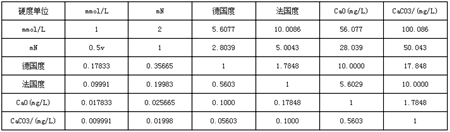
Since hardness is not formed by a single metal ion or salt, it is necessary to convert it to another salt in order to have a unified comparison standard. Usually usedCa0OrCaCO3It is expressed by the mass concentration. When the hardness is0.5mmol/LWhen, it is equal to28mg/LtheCaOOr equal to50mg/LtheCaCO3. In addition, some countries also use German scales and French scales to express hardness. 1German degree is equal to10mg/LtheCaO,1The French degree is equal to10mg/LtheCaCO3.0.5mmol/LEquivalent to208German degree5.0French degree. The relationships among common hardness units are as follows:
4 "Water" pH value
"Water"pHIt represents the negative logarithm of the hydrogen ion concentration in water, expressed as:pH=-lg[H+]
pH The value is sometimes also called the hydrogen ion index. The concentration of hydrogen ions in water can determine whether the aqueous solution is alkaline, neutral or acidic. Because the value of hydrogen ion concentration is often very small, it is very inconvenient in application, so it is used pH The concept of value is used as an indicator to judge the acidity or alkalinity of aqueous solutions. Moreover, the negative logarithm of hydrogen ion concentration can precisely reflect the quantity and magnitude of the variation range of acidity and alkalinity, making it very convenient to apply. And thus we obtain:
(1) Neutral aqueous solution pH=-lg[H+]=-lg10-7=7 ;
(2) Acidic aqueous solution pH<7 , pH The smaller the value, the stronger the acidity.
(3) Alkaline aqueous solution pH>7 , pH The larger the value, the stronger the acidity.
If pressed pH value ( Acidic or alkaline ) Further detailed classification of water quality can yield:
(1) Strongly acidic aqueous solution pH<5.0 ;
(2) Strongly acidic aqueous solution pH=5.0-6.4 ;
(3) Neutral aqueous solution pH=6.5-8.0 ;
(4) Weakly alkaline aqueous solution pH=8.1-10.1 ;
(5) Strongly alkaline aqueous solution pH>10.0 ;
5 Suspended substances in water
The suspended substances in water are particles with diameters approximately at10-4mmThe above-mentioned particles are visible to the naked eye. These particles are mainly composed of silt, clay, protozoa, algae, viruses and high-molecular organic matter, etc. They are often suspended in water flow, causing water turbidity. These particles are very unstable and can be removed through sedimentation and filtration. When water is standing still, heavy particles (mainly inorganic substances like sand and clay) will settle down. Light particles (mainly organic compounds of animals, plants and their remains) float on the water surface and can be removed by separation methods such as filtration. Suspended solids are the main source of turbidity, color and odor. Their content in water is also unstable and often varies with different seasons and regions.
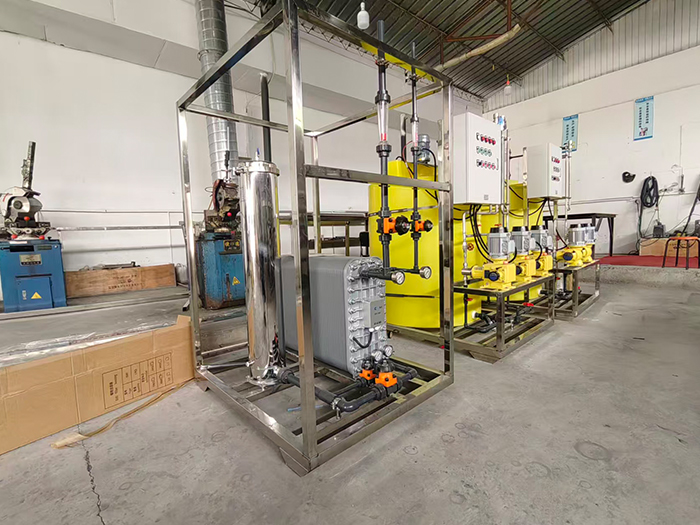
Yuan LaiEDIThe ultra-pure water equipment uses electro-deionization technology.EDIElectrodeionization is a water purification method that combines the dual advantages of electrodialysis and ion exchange. It does not require acid-base chemical regeneration and can continuously and stably prepare high-purity ultrapure water. Under the action of a direct current electric field, ion separation in water is completed. At the same time, water is electrolyzed to generate hydrogen ions and hydroxide ions, achieving automatic regeneration of the resin without the need to stop the machine for manual regeneration. The pre-treatment combined with reverse osmosis can prevent oxidized substances from damaging the resin, ensuring stable effluent quality and widely meeting the high-standard water usage requirements of various industries.
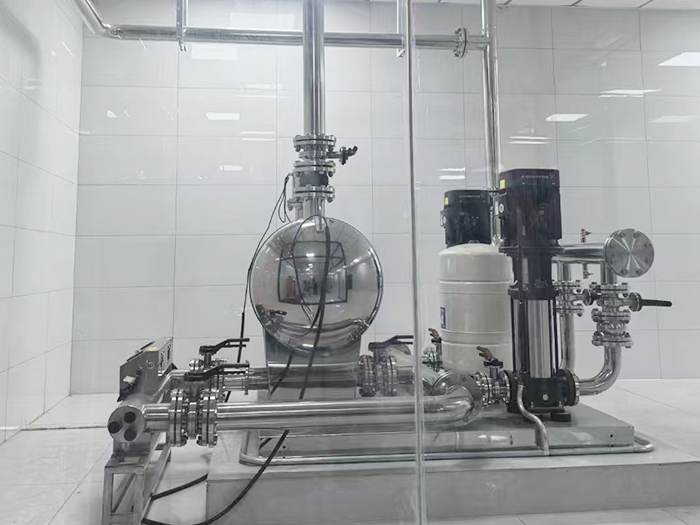
The non-negative pressure water supply equipment can be directly connected to the municipal water supply network, making full use of the residual pressure of the original network for superimposed water supply. Fully enclosed operation does not require the construction of a domestic water tank, eliminating secondary pollution. Intelligent variable frequency voltage stabilization, energy-saving, quiet and easy installation, it is the preferred equipment for secondary water supply in high-rise residential buildings and commercial buildings.
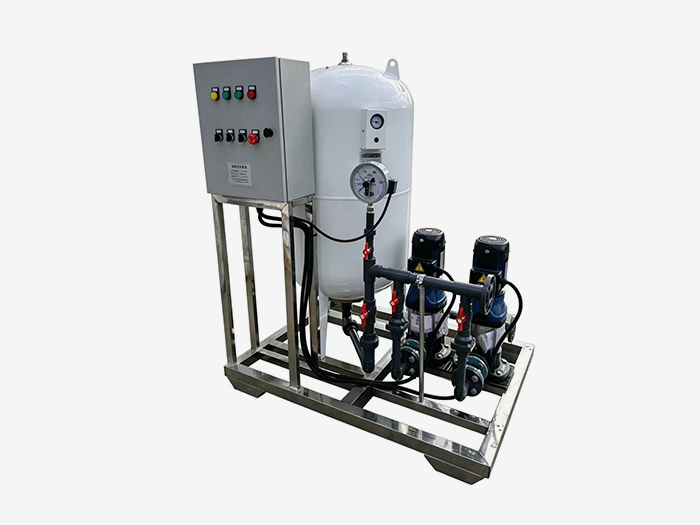
Constant pressure water supply equipment is widely used in central air conditioning, floor heating, industrial closed-loop water circulation, and boiler systems. It integrates automatic pressure stabilization, automatic water replenishment, automatic exhaust, pressure relief and buffering functions. It stabilizes the pressure in the pipeline network, eliminates abnormal sounds caused by air blockage, and prevents damage from negative pressure and water shortage in the pipeline. It is an essential supporting equipment for HVAC and circulating water systems.











 Landline:+86 010 59792055
Landline:+86 010 63780188
 Mobile:+86 13910114728
 Email:bjyuanlai@163.com
 Email:Wanda Plaza, Fengke Road, Fengtai District, BeijingBseat6Courtyard No.3Building No.7layer708
Yuanlai Homepage Softened water equipment Reverse osmosis pure water equipment Water supply equipment Engineering case Technical service Enter Yuanlai Site map
Softened water equipment Reverse osmosis pure water equipment Water purification equipment Water supply equipment Automatic dosing equipment High-purity water (ultra-pure water) equipment Wholesale of water treatment accessories
Electric power industry Petrochemical industry The electronic semiconductor industry The photovoltaic new energy industry Pharmaceuticals & Biochemical Engineering School research units Food and beverage industry Enterprises and public institutions
Reverse osmosis membrane Star-counting pump Fleck Valve Runxin Valve Instruments and meters Ultrafiltration membrane Softening resin Resin tank
