Bookmark this site Online message 中文站Welcome to the official website of Beijing Yuanlai Water Treatment Equipment Co., LTD.!
Service Hotline
+86 010 59792055 / +86 13910114728

Evaluation indicators and influencing factors of reverse osmosis membranes:
I. Evaluation index
Generally speaking, reverse osmosis membranes should possess the following properties:
①It has a large water permeability per unit area and a high desalination rate.
②It has good mechanical strength and a small compaction effect on the porous support layer.
③It has good chemical stability and is resistant to acid, alkali corrosion and microbial erosion.
④Uniform structure, long service life, and slow performance degradation;
⑤It is easy to make film, the price is low and the raw materials are abundant.Therefore, the evaluation indicators for reverse osmosis membranes can be analyzed from the following aspects:
Desalination rateThe percentage of soluble impurity concentration removed from the system feed water through reverse osmosis membranes.
Salt permeabilityThe percentage of soluble impurities in the influent that pass through the membrane.
Desalination rate=(1-Salt content in the produced water/The salt content of the influent)×100%
Salt penetration rate=100%-Desalination rate
The desalination rate of reverse osmosis membrane elements is determined during their manufacturing and forming process, and the level of desalination rate depends on Reverse osmosis The density of the ultra-thin desalination layer on the surface of the membrane element: the denser the desalination layer, the higher the desalination rate, but the lower the water production. The removal rate of different substances by reverse osmosis is mainly determined by the structure and molecular weight of the substances. Hydranautics reverse osmosis membrane elements The removal rate of high-valent ions and complex monovalent ions can exceed99%The removal rates for monovalent ions such as sodium ions, potassium ions and chloride ions are slightly lower, but still exceed98%; For molecular weight greater than100The organic matter removal rate can also be achieved 98%.
Water production volume (water flux)It refers to the production capacity of the reverse osmosis system, that is, the amount of water passing through the membrane per unit time, usually in tons/Hours or gallons/Tian Lai indicated.
Permeation flow rateIt is also an important indicator of the water production capacity of reverse osmosis membrane elements. It refers to the flow rate of the permeate per unit membrane area, usually expressed in gallons per square foot per day.GFDIt indicates. Excessively high permeation flow rate will cause the water flow rate perpendicular to the membrane surface to accelerate, exacerbating membrane fouling.
Recovery rateIt refers to the percentage of feed water in the membrane system that is converted into product water or permeate. The recovery rate of the membrane system is determined during the design stage and is based on the preset influent water quality.
The recovery rate is usually expected to be maximized to enhance economic benefits, but it should be set at the limit value that no precipitation occurs within the membrane system due to supersaturation of impurities such as salts.
Recovery rate=(Water production flow rate/Influent flow rate×100%
Ii. Influencing Factors of Reverse Osmosis
The water flux and desalination rate of reverse osmosis membranes are key operating parameters in the reverse osmosis process. These two parameters will be affected by pressure, temperature, recovery rate, feed water salt content, and feed waterPHThe influence of value factors.
1Inlet water pressure
The feed water pressure itself does not affect the salt permeation rate. However, an increase in feed water pressure raises the net pressure driving reverse osmosis, thereby increasing the water production. At the same time, the salt permeation rate remains almost unchanged. The increased water production dilutes the salt passing through the membrane, reduces the salt permeation rate, and enhances the desalination rate. When the influent pressure exceeds a certain value, due to the excessively high recovery rate, the concentration polarization is intensified, which in turn leads to an increase in salt permeation, offsetting the increased water production and causing the desalination rate to no longer increase.
2.Inlet water temperature
Temperature has a significant impact on the operating pressure, desalination rate and pressure drop of reverse osmosis. As the temperature rises, the permeability increases, and the net driving force required at a certain water flux decreases, thus the actual operating pressure drops. At the same time, the solute permeation rate also increases with the rise in temperature, and the salt permeation increases, which is directly manifested as an increase in the electrical conductivity of the product water.
Temperature also has a certain impact on the pressure drop of each section of reverse osmosis. As the temperature rises, the viscosity of water decreases, and the pressure drop reduces. For Reverse osmosis In devices where the turbulence in the membrane channels is enhanced due to fouling, the influence of viscosity on pressure drop is more pronounced.
The conductivity of the water produced by reverse osmosis membranes is highly sensitive to changes in the feed water temperature. As the water temperature increases, the water flux also increases linearly. Every time the feed water temperature rises1℃The water production flux will increase2.5%~3.0%; The reason lies in the fact that the viscosity of water molecules passing through the membrane decreases and their diffusion performance enhances. The increase in the influent water temperature will also lead to an increase in the salt permeation rate and a decrease in the desalination rate. This is mainly because the diffusion rate of salt through the membrane will accelerate with the rise in temperature.
3Water ingresspHvalue
All kinds of membrane modules have an allowable onepHValue range, water ingresspHThe value has almost no impact on the water production volume. But even within the allowable range, PHvalue Regarding the desalination rate also It has a considerable influence, on the one handpHThe value also has a certain impact on the conductivity of the product water. This is because most reverse osmosis membranes themselves contain some active groups.pHThe value can affect the electric field on the membrane surface and thereby influence the migration of ions.pHThe value has a direct impact on the form of impurities in the influent water. For example, for dissociable organic matter, its retention rate variespHIt decreases as the value drops. On the other hand, it is due to the dissolution in waterCO2bypHThe value has a significant impact.pHWhen the value is low, it is in gaseous formCO 2 The form exists and is easy to pass through the reverse osmosis membrane, sopHThe desalination rate is also relatively low at low timespHElevated, gaseous stateCO 2 Transform intoHCO 3 - andCO 3 2- Ions, and the desalination rate also gradually increasespHin7.5~8.5 the between when The desalination rate reaches a high level.
4,Influent salt concentration
Osmotic pressure is a function of the concentration of salt or organic matter in water. The higher the salt content, the greater the osmotic pressure. Under the condition that the inlet water pressure remains unchanged, the net pressure will decrease and the water production will decline. The salt penetration rate is directly proportional to The salt concentration difference between the front and back sides of the reverse osmosis membrane is that the higher the salt content of the feed water, the greater the concentration difference. The salt permeation rate increases, which in turn leads to a decrease in the desalination rate. For the same system, different salt content in the feed water leads to differences in its operating pressure and the conductivity of the product water. Every increase in the salt content of the feed waterl00ppmThe inlet water pressure requires "Increase about 0 .007MPaAt the same time, due to the increase in concentration, the conductivity of the product water also increases accordingly.
5Suspended matter
Suspended solids in water refer to the substances remaining on the surface of the filter material while water is being filtered, mainly composed of particles. High suspended solids content can cause severe blockage in reverse osmosis and nanofiltration systems very quickly, affecting the water production and water quality of the systems.
6,Recovery rate
The recovery rate has a significant impact on the pressure drop in each section. Under the condition that the total influent flow rate remains constant, an increase in the recovery rate leads to a reduction in the concentrated water flow rate passing through the high-pressure side of reverse osmosis, resulting in a decrease in the total pressure drop and an increase in the recovery rate. Actual operation shows that even if the recovery rate changes very little, such as1%It will also cause a total pressure difference to occur0.02MPaThe changes on the left and right. The influence of recovery rate on the conductivity of product water depends on the salt permeation rate and the amount of product water. Generally speaking, an increase in the system recovery rate will increase the salt content in the concentrated water and accordingly increase the conductivity of the product water.
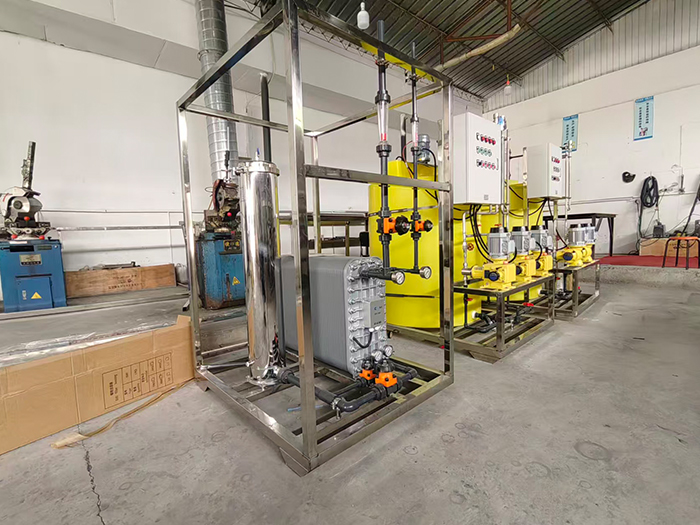
Yuan LaiEDIThe ultra-pure water equipment uses electro-deionization technology.EDIElectrodeionization is a water purification method that combines the dual advantages of electrodialysis and ion exchange. It does not require acid-base chemical regeneration and can continuously and stably prepare high-purity ultrapure water. Under the action of a direct current electric field, ion separation in water is completed. At the same time, water is electrolyzed to generate hydrogen ions and hydroxide ions, achieving automatic regeneration of the resin without the need to stop the machine for manual regeneration. The pre-treatment combined with reverse osmosis can prevent oxidized substances from damaging the resin, ensuring stable effluent quality and widely meeting the high-standard water usage requirements of various industries.
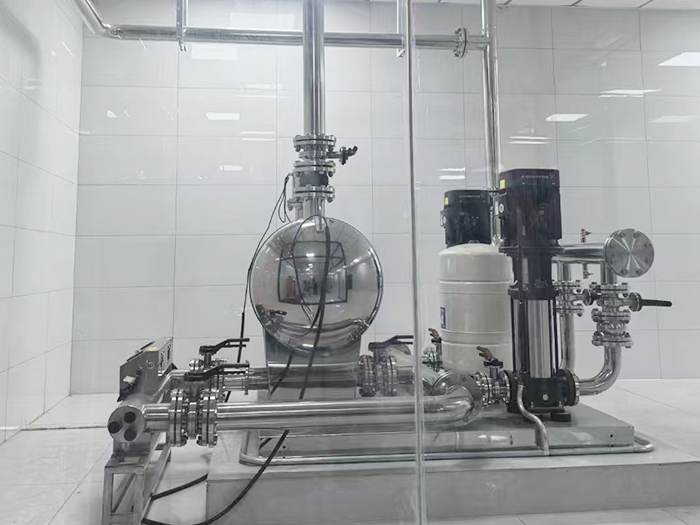
The non-negative pressure water supply equipment can be directly connected to the municipal water supply network, making full use of the residual pressure of the original network for superimposed water supply. Fully enclosed operation does not require the construction of a domestic water tank, eliminating secondary pollution. Intelligent variable frequency voltage stabilization, energy-saving, quiet and easy installation, it is the preferred equipment for secondary water supply in high-rise residential buildings and commercial buildings.
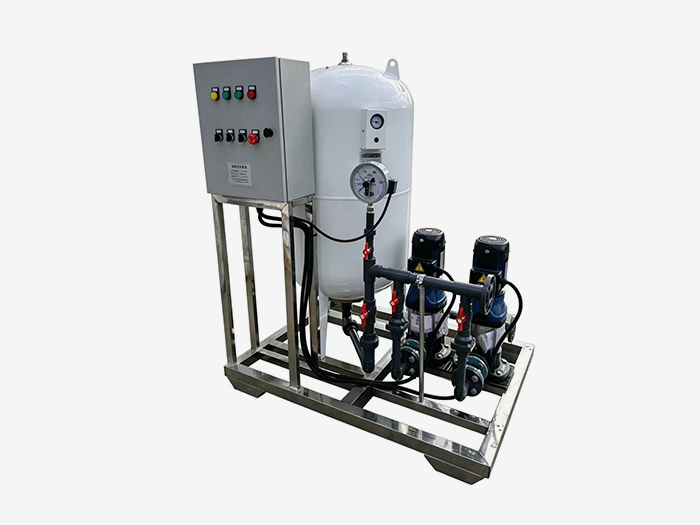
Constant pressure water supply equipment is widely used in central air conditioning, floor heating, industrial closed-loop water circulation, and boiler systems. It integrates automatic pressure stabilization, automatic water replenishment, automatic exhaust, pressure relief and buffering functions. It stabilizes the pressure in the pipeline network, eliminates abnormal sounds caused by air blockage, and prevents damage from negative pressure and water shortage in the pipeline. It is an essential supporting equipment for HVAC and circulating water systems.











 Landline:+86 010 59792055
Landline:+86 010 63780188
 Mobile:+86 13910114728
 Email:bjyuanlai@163.com
 Email:Wanda Plaza, Fengke Road, Fengtai District, BeijingBseat6Courtyard No.3Building No.7layer708
Yuanlai Homepage Softened water equipment Reverse osmosis pure water equipment Water supply equipment Engineering case Technical service Enter Yuanlai Site map
Softened water equipment Reverse osmosis pure water equipment Water purification equipment Water supply equipment Automatic dosing equipment High-purity water (ultra-pure water) equipment Wholesale of water treatment accessories
Electric power industry Petrochemical industry The electronic semiconductor industry The photovoltaic new energy industry Pharmaceuticals & Biochemical Engineering School research units Food and beverage industry Enterprises and public institutions
Reverse osmosis membrane Star-counting pump Fleck Valve Runxin Valve Instruments and meters Ultrafiltration membrane Softening resin Resin tank
