Bookmark this site Online message 中文站Welcome to the official website of Beijing Yuanlai Water Treatment Equipment Co., LTD.!
Service Hotline
+86 010 59792055 / +86 13910114728

Membrane separation technology, which is driven by pressure, when the pressure applied in the system is greater than the osmotic pressure of the feed water solution, water molecules continuously pass through the membrane, flow through the product water channel into the pipe, and then flow out from one end. Impurities in the water, such as ions, organic matter, viruses, etc., are retained on the feed water side of the membrane and then flow out from the concentrated water outlet, thus achieving the purpose of separation and purification. Reverse osmosis equipment is a process where raw water passes through fine filters, granular activated carbon filters, compressed activated carbon filters, etc., and then is pressurized by a pump to utilize pore sizes of1/10000μm(Equivalent to the size of Escherichia coli1/6000"Virus1/300)Reverse osmosis membranes(ROmembrane)It turns high-concentration water into low-concentration water, and at the same time isolates all impurities such as industrial pollutants, heavy metals, and viruses that are mixed in large quantities in the water, thereby meeting the physical and chemical indicators and hygiene standards for drinking water, and producing pure water. It is an excellent choice for the human body to replenish good water in a timely manner.BecauseROThe water produced by reverse osmosis equipment technology has the highest purity among all the water production technologies currently mastered by humans, with a cleanliness level almost reaching100%So people call this water-producing machine a reverse osmosis pure water machine.
System composition
It generally includes a pretreatment system, reverse osmosis device, post-treatment system, cleaning system and electrical control system, etc. The pretreatment system generally includes raw water pumps, dosing devices, quartz sand filters, activated carbon filters, precision filters, etc. Its main function is to reduce the pollution index and residual chlorine and other impurities of the raw water, meeting the feed water requirements for reverse osmosis. The equipment configuration of the pretreatment system should be determined based on the specific conditions of the raw water. The reverse osmosis device mainly includes multi-stage high-pressure pumps, reverse osmosis membrane elements and membrane housings(Pressure vessel)It is composed of brackets, etc. Its main function is to remove impurities from water to ensure that the effluent meets the usage requirements. The post-treatment system is an additional configuration when reverse osmosis fails to meet the effluent requirements. It mainly includes anion beds, cation beds, mixed beds, ultrafiltrationEDIOne or more of these devices. The post-treatment system can further improve the water quality of the reverse osmosis effluent to meet the usage requirements. The cleaning system mainly consists of a cleaning water tank, a cleaning water pump and a precision filter. When the reverse osmosis system is contaminated and the effluent indicators fail to meet the requirements, it is necessary to clean the reverse osmosis system to restore its effectiveness. The electrical control system is used to control the normal operation of the entire reverse osmosis system. Including instrument panels, control panels, various electrical protections, electrical control cabinets, etc.
Cleaning methods for reverse osmosis equipment
Reverse osmosis technology has been increasingly widely applied due to its unique superiority. The cleaning issue of reverse osmosis water purification equipment may cause losses to many users with weak technical capabilities. Therefore, by doing a good job in the management of reverse osmosis equipment, serious problems can be avoided.
(1).Low-pressure flushing of reverse osmosis equipment: Regularly perform high flow, low pressure, and low pressure on the reverse osmosis equipmentpHThe flushing of the value is conducive to removing the dirt adhering to the membrane surface, maintaining the membrane performance, or when the reverse osmosis equipment feeds waterSDISuddenly increase over5.5At the above times, low-pressure flushing should be carried out and waitSDITurn on the machine only after the value adjustment is qualified.
(2).Reverse osmosis equipment shutdown protection: Due to fluctuations in production, reverse osmosis equipment is inevitably shut down frequently. Protective measures should be taken during short-term or long-term shutdowns. Improper handling can lead to a decline in membrane performance that cannot be restored. Short-term storage is applicable when the service is out of service15dThe following systems can adopt each1~3dThe method of low-pressure flushing is used to protect reverse osmosis equipment. Practice has found that water temperature20℃At the above times, water is stored in the reverse osmosis equipment3dIt will go bad and stink, and multiply in large numbers. Therefore, it is recommended that the water temperature be higher than20℃Every hour, every2dor1dLow-pressure flushing once, with water temperature lower than20℃At that time, you can do it every time3dPerform a low-pressure flush once. After each flush, all the inlet and outlet valves on the reverse osmosis device of the water purification equipment should be closed. Long-term shutdown protection applies to shutdown15dFor the above-mentioned systems, protective solution should be used at this time(agent)Fill it into the reverse osmosis device of the water purification equipment for protection. Common agent formulas(Composite film)For formaldehyde10(Mass fraction)Isothiazolinone20mg/LSodium bisulfite1(Mass fraction).
(3).Chemical cleaning of reverse osmosis membranes Under normal operating conditions, reverse osmosis membranes may also be contaminated by inorganic scale, colloids, microorganisms, metal oxides, etc. The deposition of these substances on the membrane surface can cause a decrease in the output or desalination rate of the reverse osmosis device in the water purification equipment, an increase in pressure difference, and even cause irreparable damage to the membrane. Therefore, in order to restore good water permeability and desalination performance, chemical cleaning of the membrane is required. "General3~12It should be cleaned once a month. If it has to be cleaned once a month, it indicates that the pretreatment system should be in place and the operating parameters should be adjusted. If1~3If the equipment needs to be cleaned once a month, it is necessary to improve its operational level. It is rather difficult to determine whether the pretreatment system needs to be improved.
Main process flow description of reverse osmosis pure water equipment
(1). Raw water tank (Optional)Reverse osmosis equipment process diagram: It stores raw water and is used to settle large sand particles and other precipitable substances in the water. At the same time, it buffers the impact of unstable water pressure in the raw water pipe on the water treatment system.(The response of pressure sensing caused by too low or too high water pressure).
(2). Raw water pump: Constant system water supply pressure and stable water supply volume.
(3). Multi-media filter: A filter that uses multiple filtration layers. Its main purpose is to remove particles such as sand, rust, colloidal substances, and suspended matter contained in the raw water20umThe above-mentioned substances can be controlled by manual valves or fully automatic controllers for a series of operations such as backwashing and forward washing. Ensure the quality of water produced by the equipment and extend its service life.
(4). Activated carbon filter: The system adopts nut shell activated carbon filter. Activated carbon can not only adsorb electrolyte ions but also perform ion exchange adsorption. Activated carbon adsorption can also increase the oxygen consumption of potassium permanganate(COD)by15mg/L(O2)drop2~7mg/L(O2)In addition, due to the adsorption effect, the concentration of adsorbed substances on the surface increases, thus also playing a catalytic role, removing pigments, odors, a large amount of biochemical organic matter in water, reducing the residual chlorine value and pollutants in water, and eliminating trihalides in water(THM)And other pollutants. Manual valves or fully automatic controllers can be selected to control backwashing, forward washing and a series of other operations. Ensure the quality of water produced by the equipment and extend its service life. Meanwhile, the equipment is equipped with a self-maintenance system and has very low operating costs.
(5). Ion softening system/Dosing systemR/OThe device is designed to dissolve solid substances for concentrated discharge and the utilization of fresh water, and to prevent the concentrated water end, especiallyROA concentrated water side of a membrane module appears behind the deviceCaCO3,MgCO3,MgSO4,CaSO4,BaSO4, SrSO4, SiSO4When the concentration product exceeds its equilibrium solubility constant and crystallizes out, it damages the inherent characteristics of the membrane element. Before entering the reverse osmosis membrane module, an ion softening device should be used or an appropriate amount of scale inhibitor should be added to prevent carbonate.SiO2The crystallization of sulfate.
(6). Precision filter: A precision filter is used to remove residual suspended solids, non-spherical particles and colloids and other substances in the influent water, therebyROThe subsequent equipment such as the system operates more and more reliably. The filter element is5umMelt-blown filter elements are designed to prevent any leakage from the upper-level filtration unit5umThe removal of impurities. To prevent entry into the reverse osmosis device and damage to the membrane surface, thereby damaging the membrane's desalination performance.
(7). Reverse osmosis system: The reverse osmosis device is to apply sufficient pressure to the solvent in the solution(It's usually water.)Through reverse osmosis membranes(Or it is called a semi-permeable membrane)And because this process is opposite to the direction of natural osmosis, it is called reverse osmosis. Reverse osmosis can adapt to various types of raw water with different salt contents, especially in water treatment projects with high salt content, it can achieve excellent technical and economic benefits. Reverse osmosis has a higher desalination rate, higher recovery rate, stable operation, small floor space, and simple operation. While removing salt, reverse osmosis equipment also removes most colloids and large-molecular-weight organic substances.
(8). Ozone generator(Optional)Eliminate the pollution caused by secondary pollution to thoroughly ensure the hygiene standards of the finished water.
The main uses of reverse osmosis equipment:
(1)It is used to produce pure water and high-purity water required for processes in the electronics industry, such as picture tube glass shells, picture tubes, liquid crystal displays, circuit boards, computer hard disks, integrated circuit chips, and monocrystalline silicon semiconductors.
(2)It is used to produce softened water and desalinated pure water for the feed water of thermal power generation boilers, medium and low pressure boilers in factories and mines.
(3)It is used to produce pure water for large-volume medical parenterals, injections, pharmaceuticals, biochemical products, medical sterile water and pure water for artificial kidney dialysis, etc., which are required by the pharmaceutical industry.
(4)Produce beverages(Containing alcohol)Purified water, distilled water, mineral water for drinking in the industry, water for brewing alcoholic beverages and pure water for blending;
(5)The production of domestic water and drinking water from seawater and brackish water;
(6)Prepare deionized water for electroplating processes; Battery(Battery)Pure water from the production process; Water for surface coating and cleaning of automobiles, household appliances and building materials products; Pure water for coated glass Hardening and desalination water required for textile printing and dyeing processes;
(7)Petrochemical industry, such as cooling water for chemical reactions; Process pure water for the manufacturing of chemical agents, fertilizers and fine chemicals, and cosmetics;
(8)A good water supply network system for hotels, buildings, communities, airports, real estate properties and swimming pool water quality purification;
(9)Wastewater treatment and reuse in circuit boards, electroplating, and the electronics industry;
(10)The treatment of wastewater from domestic life, hospitals, leather tanning, dyeing and printing, papermaking industries, and leachate from garbage.
Reverse osmosis pure water equipmentTechnical Description
Reverse osmosis(AbbreviationRO)It is a type of membrane separation technology, which works by relying on the characteristic of reverse osmosis membranes to separate solvents and solutes in solutions under pressure. Osmosis is a physical phenomenon. Reverse osmosis occurs in water containing salt and various fine impurities(That is, raw water)Applying a greater pressure than natural osmosis causes water to reverse osmosis from the side with higher concentration to the side with lower concentration, while the vast majority of impurities, organic matter, heavy metals, and other harmful substances in the raw water are discharged through the sewage outlet.
Features and application scope of reverse osmosis pure water equipment
·It has a high desalination rate and can simultaneously remove other organic substances, and the effluent quality meets the national standardsGBI7323-1998"Standard;
·The main components of the reverse osmosis pure water equipment adopt imported composite membrane elements from the United States and imported high-pressure stainless steel pumps. Compared with other reverse osmosis elements, it has advantages in terms of feed water adaptability, desalination rate and service life.
·Design pressure1.05~1.6MpaDesalination rate96~99%;
·It features a high degree of automation, stable operation, low failure rate and low operating costs.
·Applicable to water for wine blending, water for canned product processing, bottled and barreled drinking water, and water for various beverages.
·It is applicable to the preparation of water in industries such as electronics, chemical engineering, power, and pharmaceuticals.
·It is suitable for the treatment of high-purity water.
Reverse osmosis equipment is a type of membrane separation technology that relies on selective permeation(Half-through)The membrane is used to separate water molecules from inorganic salts in water, and water molecules pass through by applying pressure on one side of the water supplyROThe membrane, while inorganic salts are retained on the other side of the membrane, thus achieving the separation and purification of water quality.
1,0.5Tons of/Typical process flow of reverse osmosis equipment
Raw water→Quartz sand filter→Activated carbon filter→Fully automatic water softener→Security filter→ROHost→Pure water storage tank The equipment can be configured according to different industries and different needs(Such as ultraviolet equipment and ozone equipment).
2The main components of reverse osmosis:
Pretreatment of reverse osmosis equipment
It is composed of a multi-media filter, an activated carbon filter and an automatic water softener.
Multi-media filter: It is composed of fully automatic control valves, fiberglass reinforced plastic tanks and quartz sand of different grade ratios. It can effectively remove suspended solids and some colloidal substances in the raw water and reduce the turbidity of the raw water. And it can automatically perform backwashing.
Activated carbon filter: It is composed of a fully automatic control valve, a good glass tank and activated carbon of different water purification grades. It can effectively adsorb harmful substances such as heavy metals, free chlorine and chloroform in the raw water. And it can automatically perform backwashing.
Grade water softener: It is composed of fully automatic control valves, high-quality fiberglass reinforced plastic tanks and grade resin. Calcium and magnesium ions in water can be effectively removed through the first-level water softener. To prevent the reverse osmosis equipment from affecting the service life of the reverse osmosis membrane due to scaling during operation. And it can regenerate automatically.
Main unit of reverse osmosis equipment
The main unit of the reverse osmosis water purification equipment mainly consists of a security filter, a high-pressure pump, reverse osmosis membranes, and various control and display instruments. Security filter: The security filter is the last line of protection before the raw water enters the membrane. It can effectively remove the leakage from the pretreatment process5μm The substance. The main purpose is to prevent suspended particles from entering the reverse osmosis membrane elements and depositing on the membrane surface to contaminate the membrane elements.
·High-pressure pump: It provides the pressure required for reverse osmosis and ensures the separation of solvents and solutes. The high-pressure pump is one of the key components of reverse osmosis equipment.
·Reverse osmosis membrane group: A reverse osmosis membrane group is composed of polymer fibers with a highly ordered matrix structure. Its aperture is1-10An, that is, from one billionth of a meter to one billionth of a meter(It is one six-thousandth the size of Escherichia coli and one three-thousandth the size of a virus)By taking advantage of the separation characteristics of reverse osmosis membranes, impurities such as dissolved salts, colloids, organic matter, heavy metals, trihalomethane intermediates produced by chlorination, and microorganisms in solvents can be effectively removed.
·Reverse osmosis membrane housing: It is used to accommodate reverse osmosis membrane elements, withstand pressure and create a high-pressure environment for reverse osmosis operations.
·Flowmeters: Pure water flowmeters and concentrated water flowmeters measure separatelyROInstant flow of pure water and concentrated water.
·Pressure gauge: Measures water pressure at various locations of the reverse osmosis equipment.
·Concentrated water regulating valve: used for regulationROThe operating pressure of the equipment, the ratio of pure water to concentrated water, and the output of pure water.
·Conductivity meter: Monitors the conductivity of reverse osmosis effluent.
·Low-voltage switch: PreventionROThe high-pressure pump is idling or operating at a pressure exceeding the ultimate low pressure.
·Liquid level controller: Automatically stops or starts the reverse osmosis equipment based on the liquid levels in the raw water tank and the pure water tank.
·The electrical control system: It includes instruments and meters such as conductivity meters and control equipment, and is used to control reverse osmosis equipment.
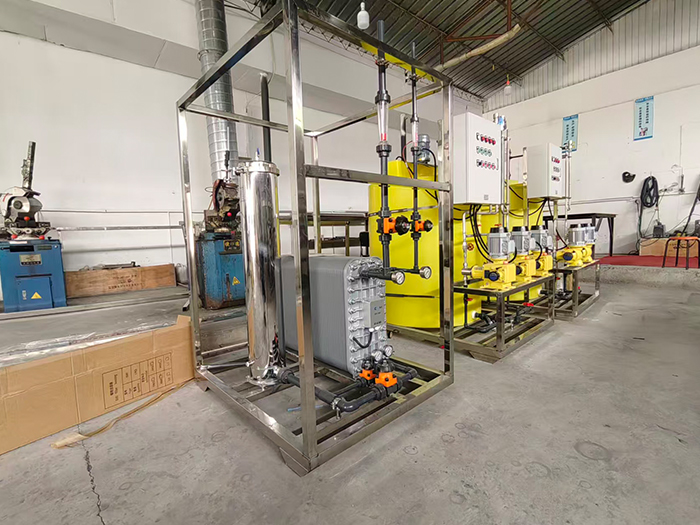
Yuan LaiEDIThe ultra-pure water equipment uses electro-deionization technology.EDIElectrodeionization is a water purification method that combines the dual advantages of electrodialysis and ion exchange. It does not require acid-base chemical regeneration and can continuously and stably prepare high-purity ultrapure water. Under the action of a direct current electric field, ion separation in water is completed. At the same time, water is electrolyzed to generate hydrogen ions and hydroxide ions, achieving automatic regeneration of the resin without the need to stop the machine for manual regeneration. The pre-treatment combined with reverse osmosis can prevent oxidized substances from damaging the resin, ensuring stable effluent quality and widely meeting the high-standard water usage requirements of various industries.
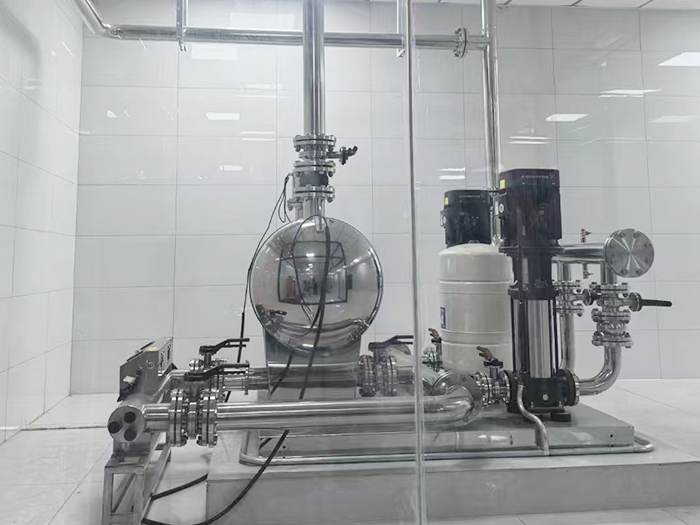
The non-negative pressure water supply equipment can be directly connected to the municipal water supply network, making full use of the residual pressure of the original network for superimposed water supply. Fully enclosed operation does not require the construction of a domestic water tank, eliminating secondary pollution. Intelligent variable frequency voltage stabilization, energy-saving, quiet and easy installation, it is the preferred equipment for secondary water supply in high-rise residential buildings and commercial buildings.
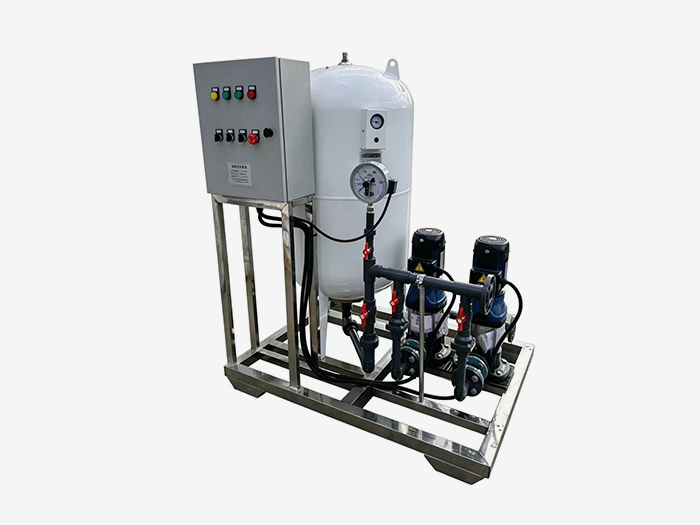
Constant pressure water supply equipment is widely used in central air conditioning, floor heating, industrial closed-loop water circulation, and boiler systems. It integrates automatic pressure stabilization, automatic water replenishment, automatic exhaust, pressure relief and buffering functions. It stabilizes the pressure in the pipeline network, eliminates abnormal sounds caused by air blockage, and prevents damage from negative pressure and water shortage in the pipeline. It is an essential supporting equipment for HVAC and circulating water systems.











 Landline:+86 010 59792055
Landline:+86 010 63780188
 Mobile:+86 13910114728
 Email:bjyuanlai@163.com
 Email:Wanda Plaza, Fengke Road, Fengtai District, BeijingBseat6Courtyard No.3Building No.7layer708
Yuanlai Homepage Softened water equipment Reverse osmosis pure water equipment Water supply equipment Engineering case Technical service Enter Yuanlai Site map
Softened water equipment Reverse osmosis pure water equipment Water purification equipment Water supply equipment Automatic dosing equipment High-purity water (ultra-pure water) equipment Wholesale of water treatment accessories
Electric power industry Petrochemical industry The electronic semiconductor industry The photovoltaic new energy industry Pharmaceuticals & Biochemical Engineering School research units Food and beverage industry Enterprises and public institutions
Reverse osmosis membrane Star-counting pump Fleck Valve Runxin Valve Instruments and meters Ultrafiltration membrane Softening resin Resin tank
