Bookmark this site Online message 中文站Welcome to the official website of Beijing Yuanlai Water Treatment Equipment Co., LTD.!
Service Hotline
+86 010 59792055 / +86 13910114728

I. Overview
This machine adopts single-stage low-pressure reverse osmosis technology to purify tap water. Combined with a carefully designed filtration and adsorption system, it can effectively remove various substances in water that are harmful to health, such as residues and heavy metal ions, and can also remove carcinogenic and pathogenic substances like fluorine that cannot be removed by conventional methods. The conductivity of tap water in the vast majority of regions in China is≤500us/cmTherefore, when using this water machine, it is essential to pay attention to the quality of the raw water and strictly follow the instructions for operation, maintenance and upkeep. The conductivity of the purified water produced can be maintained within the national standard requirements10us/cmBelow, ensure that the pure water produced for direct drinking complies with the regulations issued by the Health Supervision Department1998"19Attachment of Document Number4Hygiene requirements and the Ministry of HealthGB5749-85"Hygienic Standard for Drinking Water"
This machine integrates the complete and standardized production process of drinking purified water into one. It features an open cabinet design and is easy to maintain and service. The reverse osmosis program controller is adopted to control the automatic operation of the system. The operation process and faults are displayed on the panel, making the operation simple. The switch system only requires one switch to complete, which greatly improves the stability of the system operation. It can serve as the core equipment for water purification houses in communities, industrial zones, oil fields, etc., and also as water treatment equipment for industries such as beverages, chemicals, hospitals, and electronics.
Influent water quality: Must complyGB5749-85"Hygienic Standard for Drinking Water", and electrical conductivity≤500us/cmTap water.
Effluent quality: Complies with the "Regulations issued by the Ministry of Health's Health Supervision Department1998"19The "Hygiene" requirements of Document No. 1.
Ii. Main Parameters
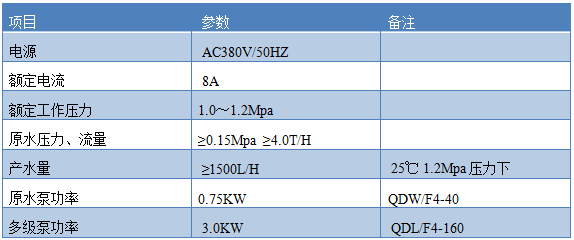
The working cycle of each device is as follows:
1Quartz sand filter
Cumulative work2900When the time is small, the quartz sand filter material should be replaced.
2Activated carbon adsorption filter
When the residual chlorine content at the outlet>0.1mg/LAt that time, the activated carbon filter material should be replaced. Generally, it works cumulatively720The activated carbon filter material should be replaced after hours.
3Security filter
Under normal circumstances, cumulative work720The fine filter element should be replaced after hours. Outlet pressure when the fine filter is in operation<0.04MpaWhen the water shortage indicator light on the panel is on, the fine filter element should also be replaced
4Reverse osmosis filter
Cumulative work240After hours, it should be cleanedROFilm once.
Cumulative work2900It should be replaced after hoursROMembrane.
Special note: For your safety, please make sure the machine's grounding wire is reliably grounded.
Iii. Operating Instructions for the Preprocessor: Two-stage reverse osmosis equipment
1Operating Instructions for multi-media filter:
APlace the multi-media filter in an appropriate location, remove the manual multi-way filter valve at the top of the filter, fill coarse and fine quartz sand in the order from bottom to top, and then tighten the multi-way valve at the top.
BConnect the water source and power supply.
CRefer to the arrow and text diagram of the multi-way valve to backwash and forward wash the filter material in the multi-media filter until the effluent from the filter is clear. Then, turn the multi-way valve to the working position.
DThe quartz sand is packaged naked to ensure the filtration effect. (Note: It should not be bagged
2Operating Instructions for Activated carbon adsorption filter:
APlace the activated carbon adsorption filter in a suitable location. Remove the manual multi-way filter valve at the top of the filter. Fill the bottom with coarse quartz sand in the order from bottom to top, then fill the activated carbon and tighten the multi-way valve at the top.
BConnect the water source and power supply.
CRefer to the arrow and text diagram of the multi-way valve to backwash and forward wash the filter material inside the activated carbon adsorption filter until the effluent from the filter is clear. Then, turn the multi-way valve to the working position.
DThe activated carbon is packaged naked to ensure the filtration effect. (Note: It should not be bagged
3Operating Instructions for resin softening filter:
APlace the resin softening filter in a suitable location, remove the manual multi-way softening valve at the top of the filter, fill it with cationic softening resin, and tighten the multi-way valve at the top.
BConnect the water source and power supply.
CInlet water softening and filtration operation:
Refer to the arrow and text diagram of the multi-way valve to backwash and forward wash the filter material inside the resin softening filter until the effluent from the filter is clear. Then, turn the multi-way valve to the working position. Note: When starting to take in water, the water inlet valve should be opened first1/3After water comes out of the drain of the water softener, slowly open the inlet valve.
DResin regeneration operation steps
Just follow the sequence of backwashing, salt drawing, water addition, forward washing and operation. Note that there should always be salt but no water in the salt tank, that is, the salt solution is in a saturated state.
Note: When performing the flushing and regeneration work on the pretreatment, please turn the raw water pump switch to the manual position. During normal operation, please turn the raw water pump switch to the automatic position. Only in this way can the equipment work normally.
Iv. Operation Steps for Equipment Installation and Commissioning:Two-stage reverse osmosis equipment
1Place the main unit and preprocessor near the water source and power supply.
2It is filled with filter materials such as quartz sand, activated carbon and softening resin.
3Connect the waterways: Connect the inlet of the raw water pump to the water source, connect the outlet of the pre-filter to the inlet of the main unit, and connect the drainage outlets of the pre-treatment unit and the main unit to the sewer with pipelines.
4Circuit: First, ensure the grounding wire is reliably grounded, and then connect the power cord provided randomly to the electrical control box in the room.
5Connect the water source and power supply, and follow the steps as required in the "Pretreatment Operation Instructions" to complete the pretreatment debugging operation.
6To use this machine, set the switch of the raw water pump to the automatic position and unscrew the stop switch. Connect the water source and power supply. When the pressure at the outlet of the multistage pump reaches the set value of the pressure controller, the multistage pump starts to work. After the multistage pump is started, adjust the system pressure to1.0-1.2Mpa. Initiate responseROThe membrane system is manually flushed30Minutes.
Installation precautions for the entire machine
1The installation site of the equipment should be flat, clean and tidy, and close to power and water sources.
2Do not approach fire sources or any heating elements.
3In northern regions, equipment must not be installed outdoors to prevent internal freezing, which could damage the instruments and filter elements.
4The installation location of the equipment should facilitate drainage and keep the drainage pipe of the equipment unobstructed.
1When the water source pressure<0.12Mpa. "Traffic"<4.0T/HDuring the operation of this machine, the multistage pump will repeatedly start---Stop---The phenomenon of startup. At this point, the machine should be stopped from use to prevent the motor from burning out. In areas with insufficient water pressure and flow, please add a raw water tank in front of this equipment.
(2The working pressure of the water pump used in the system is ensured to be within1.0-1.2MpaMake sure the water pump operates within its rated head range.
Five: Water Production Operation:Two-stage reverse osmosis equipment
1Switch the raw water pump switch on the operation panel to the automatic position, turn on the stop switch, connect the water source, and close the power supply. When the water pressure reaches the set value of the pressure controller, the equipment will start working automatically.
2After the entire machine has entered the working state, adjust the system pressure1.0-1.3Mpa.
3If it is difficult to start the multistage pump, slightly close the outlet pressure reducing regulating valve (but do not fully close it; a certain flow rate should be reserved). After the multistage pump starts, unscrew it.
4If the inlet water pressure is too low or the flow rate is insufficient, please use a raw water tank or build a water storage pool for the equipment to operate normally.
Six: Precautions during OperationTwo-stage reverse osmosis equipment
1The water output of this machine depends on the water temperature25℃At that time1500L/HAs mentioned above, the water temperature rises or drops1℃The water production will increase or decrease accordingly3%Left and right, this isROIt is determined by the characteristics of the membrane.
2EnterROThe residual chlorine content in the water of the membrane should be strictly controlled0.1PPmThe method is as follows: Connect water to the sampling port of the adsorption filter and test it with a residual chlorine detector. If the standard is exceeded, the activated carbon filter material should be replaced.
3When the water inflow is insufficient or the pressure is too low, the water shortage and under-pressure system of this machine will automatically shut down the equipment.
4When this machine is used for the first time, due to the presence of preservatives in the membrane. The conductivity of the effluent will be relatively high. Rinse1-2If water is produced normally for a period of time, the conductivity of the effluent water will decrease significantly.
Note
1If you choose itAC380VFor the motor with voltage, it is essential to ensure that the rotation direction of the motor is consistent with the rotation direction marked on the pump; otherwise, the water pump may be damaged.
2When the water source is short of water or the pressure is too low, this machine will automatically shut down. It will automatically restart when the water source pressure is restored.
3Automatic flushing: Executed upon startup of the equipment90STime flushing is completed, and it automatically switches to water production work. Each time the machine is turned on or the water is full during operation, it should be flushed10S; Continuous operation3hOr wait until the water is full3hAutomatic intervention for flushing10S. When flushing the membrane, the system pressure drops. Please do not adjust the regulating valve.
4When operating normally for water production, the pressure of the membrane system should be at1.0-1.3MpaBetween them (adjusted through the regulating valve).
5The conductivity value displayed by the conductivity meter is for reference only.
Seven: Maintenance and CareTwo-stage reverse osmosis equipment
AReplace the activated carbon in the adsorption filter
1Residual chlorine can causeROMembrane decomposition, shorteningROThe membrane life should be tested for residual chlorine content once a week.
2When the residual chlorine content exceeds0.1PPmAt that time, the activated carbon filter material should be replaced.
BReplace the fine filter element in the security filter
1The filter is equipped with5The root5um×20The inch fine filter core effectively blocks activated carbon particles, ensuringROThe membrane and pump should be replaced when they are clogged.
2When replacing, open the top cover of the security filter, remove the old filter element, replace it with a new one, and then tighten the cylinder.
Viii.ROMembrane cleaning methodTwo-stage reverse osmosis equipment
AWhen cleaning is needed
After this machine has been in use for a period of time, due to the reaction of substances such as hardness ions, organic matter colloids, etc. in the waterROThe contamination on the membrane surface, in additionROThe concentration polarization phenomenon unique to the membrane itself will all causeROFouling on the membrane surface can lead to a decrease in water volume or a desalination rate lower than the rated value. When it cannot be restored merely by daily physical flushing methodsROWhen ensuring the normal working performance of the membrane, it is necessary to have a correct understandingROThe membrane undergoes chemical cleaning.
BCleaning method:
1Prepare one60LPlastic clean containers, for use2A hose is respectively connected to the water inlet of the booster pump and the drainage outlet of the main unit, with the other end of the hose placed in the container (as shown in the figure below).
2Put it in the container50LPour in pure water1packageROStir the membrane cleaning agent thoroughly and evenly.
3,ROSwitch the flushing switch to the manual position.
4When the raw water switch is set to the manual position, the main unit will automatically start to clean the first-stage membrane.1Turn off the power after an hour.
5After the machine stops, restore the pipeline to its normal working state.
6"Right"ROThe membrane systems are arranged separately30Rinse for a minute.
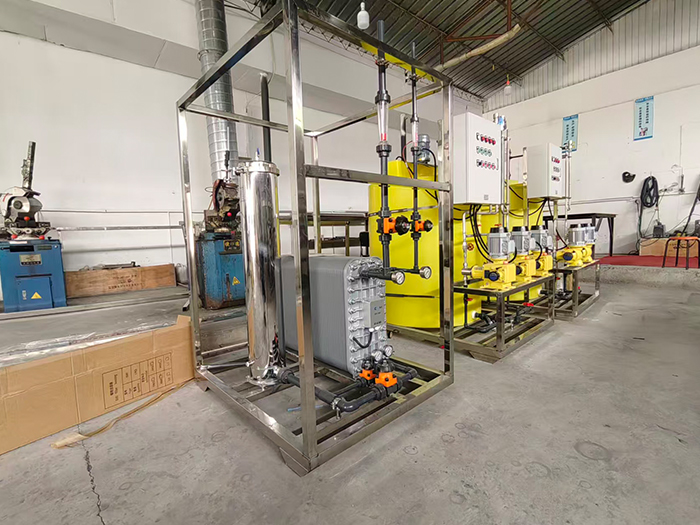
Yuan LaiEDIThe ultra-pure water equipment uses electro-deionization technology.EDIElectrodeionization is a water purification method that combines the dual advantages of electrodialysis and ion exchange. It does not require acid-base chemical regeneration and can continuously and stably prepare high-purity ultrapure water. Under the action of a direct current electric field, ion separation in water is completed. At the same time, water is electrolyzed to generate hydrogen ions and hydroxide ions, achieving automatic regeneration of the resin without the need to stop the machine for manual regeneration. The pre-treatment combined with reverse osmosis can prevent oxidized substances from damaging the resin, ensuring stable effluent quality and widely meeting the high-standard water usage requirements of various industries.
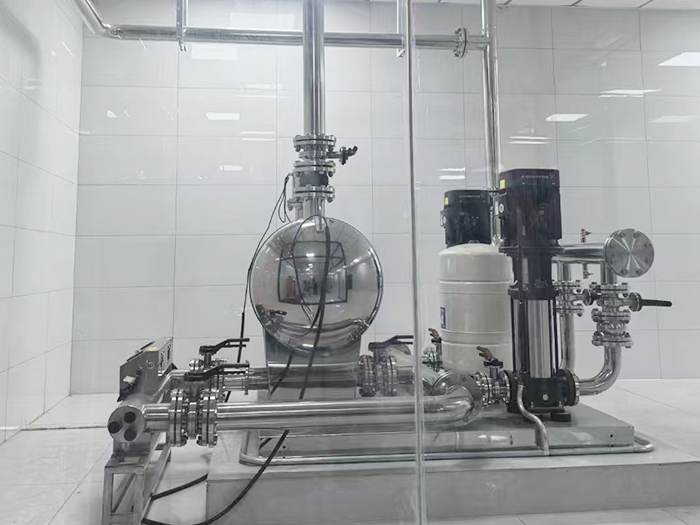
The non-negative pressure water supply equipment can be directly connected to the municipal water supply network, making full use of the residual pressure of the original network for superimposed water supply. Fully enclosed operation does not require the construction of a domestic water tank, eliminating secondary pollution. Intelligent variable frequency voltage stabilization, energy-saving, quiet and easy installation, it is the preferred equipment for secondary water supply in high-rise residential buildings and commercial buildings.
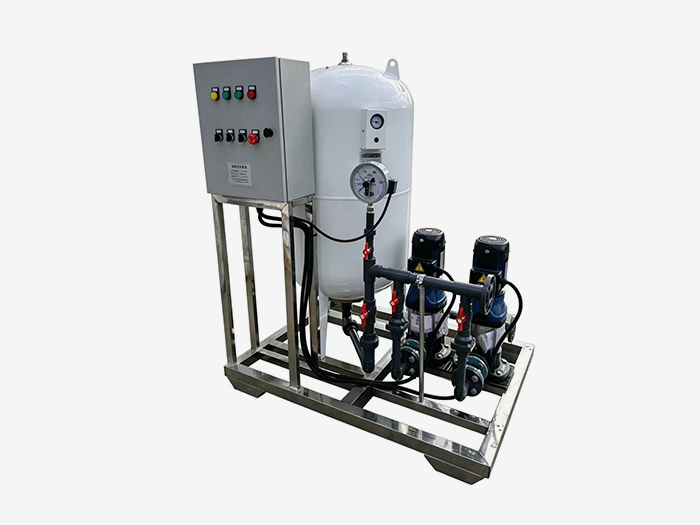
Constant pressure water supply equipment is widely used in central air conditioning, floor heating, industrial closed-loop water circulation, and boiler systems. It integrates automatic pressure stabilization, automatic water replenishment, automatic exhaust, pressure relief and buffering functions. It stabilizes the pressure in the pipeline network, eliminates abnormal sounds caused by air blockage, and prevents damage from negative pressure and water shortage in the pipeline. It is an essential supporting equipment for HVAC and circulating water systems.











 Landline:+86 010 59792055
Landline:+86 010 63780188
 Mobile:+86 13910114728
 Email:bjyuanlai@163.com
 Email:Wanda Plaza, Fengke Road, Fengtai District, BeijingBseat6Courtyard No.3Building No.7layer708
Yuanlai Homepage Softened water equipment Reverse osmosis pure water equipment Water supply equipment Engineering case Technical service Enter Yuanlai Site map
Softened water equipment Reverse osmosis pure water equipment Water purification equipment Water supply equipment Automatic dosing equipment High-purity water (ultra-pure water) equipment Wholesale of water treatment accessories
Electric power industry Petrochemical industry The electronic semiconductor industry The photovoltaic new energy industry Pharmaceuticals & Biochemical Engineering School research units Food and beverage industry Enterprises and public institutions
Reverse osmosis membrane Star-counting pump Fleck Valve Runxin Valve Instruments and meters Ultrafiltration membrane Softening resin Resin tank
