Bookmark this site Online message 中文站Welcome to the official website of Beijing Yuanlai Water Treatment Equipment Co., LTD.!
Service Hotline
+86 010 59792055 / +86 13910114728

Time-type and flow-type fully automatic water softening equipment
Our company adopts the multi-way valve control system of American companies such as Artuzu and Fulaike, and designs and produces the fully automatic water softening equipment in combination with national conditions. It is widely used in the preparation of industrial and civil softened water, such as boiler water supply, heating, supplementary water for air conditioning systems, and good domestic water, etc. The fully automatic softening system mainly consists of multi-way valves, controllers, resin tanks and salt tanks. The multi-way valve is designed with multiple channels in the same valve body. Technical parameters of the softener: 1) Raw water hardness; 6[H+]mmol/L, that is, 300 mg/L (calculated as CaCO3). When the raw water hardness is between 6 and 12[H+]mmol/L, 3) It is recommended to adopt two-stage softening or appropriately reduce the effluent production. 4) When the raw water hardness
Details >Installation and Operation Manual for Softener
The foundation of the installation site should be flat without any protrusions or depressions, and there should be drainage measures within 1 meter around the equipment. It is recommended to install a pipe filter on the inlet pipe to prevent particles such as stones and welding slag from entering the valve body. Before use, the pipeline needs to be flushed to prevent the valve body from being blocked and the resin from being contaminated. The inlet and outlet pipes of the valve body are installed correctly. "IN" is the inlet and "OUT" is the outlet (or installed according to the inlet and outlet marks). Both the inlet and outlet must be equipped with union joints and valves, and the inlet valve must not be closed. It is recommended to install a bypass valve to ensure a water supply during maintenance. The water distributor and pipes should be installed properly to ensure that the water flow direction of the valve body is correct under all working conditions. The power supply should be connected near the control valve and ensure stable power supply for 24 hours. (220V, 50Hz) 6 salt tanks are placed near the resin tank
Details >Equipment for removing iron, fluoride and manganese from rural well water
Grade 1:1. Overview: Quartz sand filters are used to remove suspended particulate matter from water and reduce the turbidity of the effluent. Activated carbon filters are used to remove color, odor, residual chlorine and organic matter. The water flow direction of the equipment operation adopts a top-down direction, which arranges the particle size of the quartz sand filter material from large to small along the water flow direction. This filtration method can greatly exert the interception effect of each part of the filter material in the filter layer, thereby improving the filtration efficiency. Activated carbon filters are used for advanced treatment of effluent, improving the quality of effluent and enhancing the reliable and stable operation of equipment. 2. Feature a: Large filtration surface and high removal rate, providing necessary protection for the subsequent water treatment system. b. The functional structure is complete and reasonable, and the use is reliable. It is easy to operate, has a long filter material replacement cycle and low maintenance costs. 3
Details >A comparative description of the process for pharmaceutical purified water equipment
1. Recommended new process flow: The use of ion exchange resin has the advantages of low initial investment and less space occupation. However, the disadvantages are that it requires frequent ion regeneration, consumes a large amount of acid and alkali, and causes certain damage to the environment. 2. Traditional process flow: Reverse osmosis is used as pretreatment, combined with ion exchange equipment. Its characteristic is that the initial investment is higher than that of the ion exchange resin method, but the regeneration cycle of the ion equipment is relatively longer, and the consumption of acid and alkali is much less than that of the ion resin method alone. However, it still has a certain degree of damage to the environment. 3. New process flow: Reverse osmosis is used as pretreatment and combined with an electro-deionization (EDI) device. This is currently an economical and environmentally friendly process for producing purified water. It can continuously produce purified water without the need for acid and alkali regeneration, causing little damage to the environment.
Details >Common water treatment methods and principles
Common water treatment methods include: (1) sediment filtration, (2) hard water softening, (3) activated carbon adsorption, (4) deionization, (5) reverse osmosis, (6) ultrafiltration, (7) distillation, (8) ultraviolet method, (9) biochemical method, etc. Now, the principles and functions of these treatment methods will be explained one by one here. The purpose of the sediment filtration method is to thoroughly remove suspended particulate matter or colloidal substances from the water source. If these particulate substances are not cleaned up, they can cause damage to other precise filter membranes of dialysis water or even clog the waterways. Therefore, this step is often used in the preliminary treatment of water purification, or when necessary, several more filters are added to the pipeline to clean larger volumes
Details >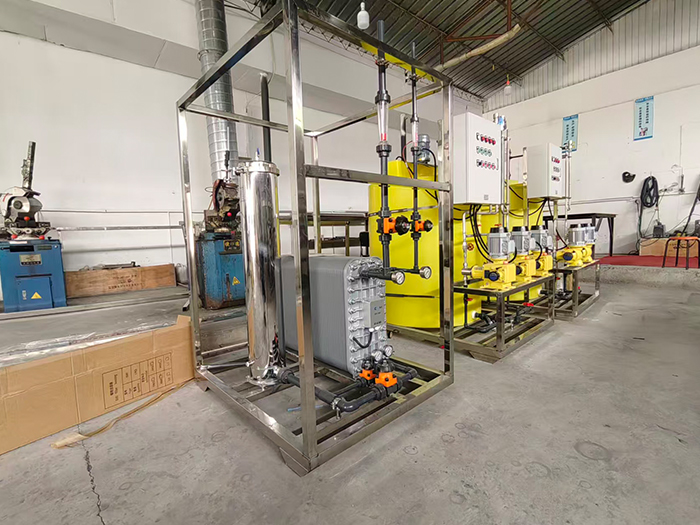
Yuan LaiEDIThe ultra-pure water equipment uses electro-deionization technology.EDIElectrodeionization is a water purification method that combines the dual advantages of electrodialysis and ion exchange. It does not require acid-base chemical regeneration and can continuously and stably prepare high-purity ultrapure water. Under the action of a direct current electric field, ion separation in water is completed. At the same time, water is electrolyzed to generate hydrogen ions and hydroxide ions, achieving automatic regeneration of the resin without the need to stop the machine for manual regeneration. The pre-treatment combined with reverse osmosis can prevent oxidized substances from damaging the resin, ensuring stable effluent quality and widely meeting the high-standard water usage requirements of various industries.
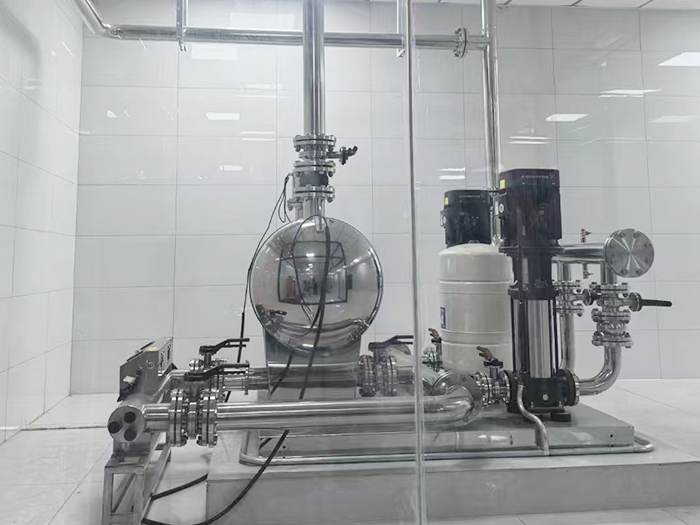
The non-negative pressure water supply equipment can be directly connected to the municipal water supply network, making full use of the residual pressure of the original network for superimposed water supply. Fully enclosed operation does not require the construction of a domestic water tank, eliminating secondary pollution. Intelligent variable frequency voltage stabilization, energy-saving, quiet and easy installation, it is the preferred equipment for secondary water supply in high-rise residential buildings and commercial buildings.
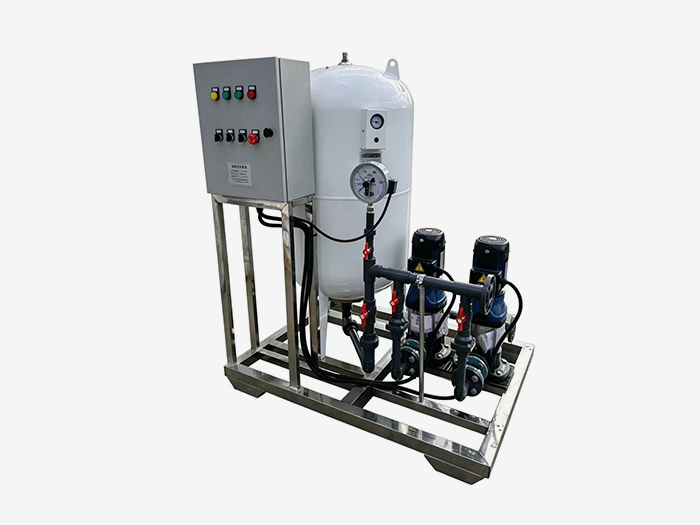
Constant pressure water supply equipment is widely used in central air conditioning, floor heating, industrial closed-loop water circulation, and boiler systems. It integrates automatic pressure stabilization, automatic water replenishment, automatic exhaust, pressure relief and buffering functions. It stabilizes the pressure in the pipeline network, eliminates abnormal sounds caused by air blockage, and prevents damage from negative pressure and water shortage in the pipeline. It is an essential supporting equipment for HVAC and circulating water systems.











 Landline:+86 010 59792055
Landline:+86 010 63780188
 Mobile:+86 13910114728
 Email:bjyuanlai@163.com
 Email:Wanda Plaza, Fengke Road, Fengtai District, BeijingBseat6Courtyard No.3Building No.7layer708
Yuanlai Homepage Softened water equipment Reverse osmosis pure water equipment Water supply equipment Engineering case Technical service Enter Yuanlai Site map
Softened water equipment Reverse osmosis pure water equipment Water purification equipment Water supply equipment Automatic dosing equipment High-purity water (ultra-pure water) equipment Wholesale of water treatment accessories
Electric power industry Petrochemical industry The electronic semiconductor industry The photovoltaic new energy industry Pharmaceuticals & Biochemical Engineering School research units Food and beverage industry Enterprises and public institutions
Reverse osmosis membrane Star-counting pump Fleck Valve Runxin Valve Instruments and meters Ultrafiltration membrane Softening resin Resin tank
