Bookmark this site Online message 中文站Welcome to the official website of Beijing Yuanlai Water Treatment Equipment Co., LTD.!
Service Hotline
+86 010 59792055 / +86 13910114728

The working principle of softening: Softening technology is an ion exchange device that fills cation exchange resin in an exchange container. Its full name is cation exchange column, and it is abbreviated as softening bed. The application of softening beds: Softening beds are generally used before reverse osmosis devices to reduce or remove waterCa2+,Mg2+The effect of ions prolongs the time for inorganic salt scaling in reverse osmosis systems and protects the reverse osmosis membrane system. It can also be setEDIIn front of the electro-deionization device, enterEDI"Water"......
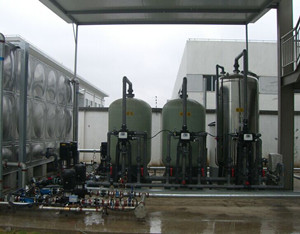
Beijing Yuanlai1T/HDetailed description of the two-stage reverse osmosis purified water system, ultra-pure water equipment, and water treatment equipment: Reverse osmosis technology is one of the most energy-efficient and effective separation technologies today.Reverse osmosis(revereomoi)Also known as reverse osmosisROReverse osmosis is a process that uses sufficient pressure to separate the solvent (usually water) in a solution through a reverse osmosis membrane (semi-permeable membrane). As it is opposite to the direction of natural osmosis, it is called reverse osmosis. It is recommended that users provide the raw water before choosing the reverse osmosis device......
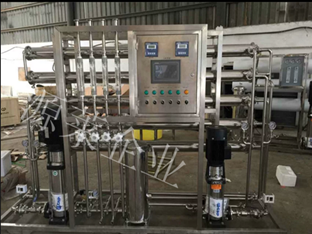
0.25The ton double-stage reverse osmosis pure water equipment utilizes the reverse osmosis principle to remove any suspended solids, soluble salts, and organic and inorganic chemical pollutants from water. It is widely applied in industries such as beverages, brewing, electronics, chemical engineering, power, and pharmaceuticals. It is divided into primary reverse osmosis and secondary reverse osmosis equipment. Raw water (tap water, surface water, groundwater) undergoes a pretreatment system and a precision filter, and is then sent to the reverse osmosis device through a high-pressure pump to directly produce product water as a single unit......
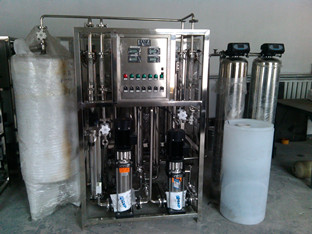
As the requirements for modern products become increasingly refined, the water quality requirements for the production of components are also very high. Ordinary pure water can no longer meet the production requirements. Next, let's take a look at what are the common process flows of deionized water equipment? 1. Deionized water equipment process types: Pretreatment (i.e., sand-carbon filter + precision filter)+ reverse osmosis + mixed bed process. This method is currently widely adopted because the investment cost of reverse osmosis is not high. It can remove 90% of the ions in the water, and the remaining ions are then removed through mixed bed exchange. In this way, the conductivity of the effluent water can be around 0.06. This is the currently popular method. The first method: The pretreatment uses a reverse osmosis device in the same way as the first method, but the mixed bed used later is replaced by an EDI continuous desalination membrane block. Thus, there is no need for acid and alkali regeneration of the resin, but
Daily maintenance methods for reverse osmosis equipment in pure water processes Reverse osmosis is an important part of pure water treatment processes. Reverse osmosis refers to membrane separation technology that uses pressure as the driving force through membranes. Reverse osmosis equipment is the product of membrane separation technology. After the raw water passes through fine filters, activated carbon filters, iron and manganese removal devices and other equipment, through the action of pumps, the reverse osmosis membrane is used to reduce the water concentration. At the same time, industrial pollutants, heavy metals, viruses and other harmful substances in the water quality are filtered out, making the water meet the physical and chemical indicators and hygiene standards for drinking. The cleaning method for reverse osmosis equipment in the pure water process: ① Select the cleaning agent formula, prepare the cleaning solution in the cleaning water tank, circulate the cleaning solution with a pump, stir it evenly and set it aside. ② Close the inlet and outlet water valves and the discharge valve on the reverse osmosis device, and then open the reverse osmosis device
Overview of Yuanlai RO Reverse Osmosis Equipment: RO reverse osmosis equipment and ro pure water treatment equipment effectively remove dissolved salts, colloids, microorganisms, organic matter, etc. from water by using reverse osmosis membrane separation technology. It can produce pure water and high-purity water to meet the needs of users in different industries and with different demands. Reverse osmosis (abbreviated as RO) is a type of membrane separation technology. The principle of Yuanlai RO reverse osmosis equipment is: using sufficient pressure to make the solvent (usually water) in the solution pass through the reverse osmosis membrane to separate the water out. Because its operation is opposite to the normal osmosis process in nature, it is called reverse osmosis (or reverse osmosis). With the development of membrane technology and the continuous improvement of membrane performance, reverse osmosis technology will evolve into a new chemical separation technology for water separation, classification and purification treatment. The Yuanlai RO reverse osmosis equipment reverse osmosis system consists of its pretreatment, reverse osmosis device and post-treatment
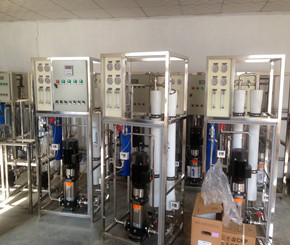
After many users purchased reverse osmosis devices, they found that the water production of the reverse osmosis devices began to decline. In response to this phenomenon, we will explain to users the reasons for the decrease in the water production of reverse osmosis equipment. 1. Reduction of reverse osmosis membranes. Operate according to the number of membranes initially designed. 2. Low-voltage operation. It should be operated in accordance with the working pressure required by the equipment. 3. Membrane module compaction occurs. When the pressure exceeds the standard, the membrane module will become compacted. At this point, the membrane module needs to be replaced. 4. The working temperature drops. It should operate in accordance with the prescribed temperature. 5. Oil has entered. It should be noted that oily substances must not enter the equipment. 6. Operate at a high recovery rate. When the recovery rate is higher than 75%, the concentrated water decreases and the concentrated water in the membrane rises, resulting in a decline in the produced water.
The main reasons for the decline in the water production capacity of water treatment equipment are as follows: 1. The reduction in the number of membrane modules. 2. The membrane modules should be compacted in accordance with the designed number of membrane modules. When operating under conditions far exceeding the reference pressure, the membrane module will become compacted. Replace the membrane module. 3. Operate under conditions of higher recovery rate. When operating under a recovery rate of over 75%, the volume of concentrated water decreases, which leads to an increase in the water concentration ratio within the membrane module. As a result, the quality of the feed water deteriorates significantly. Due to the increase in osmotic pressure of this feed water, the permeation volume decreases. In severe cases, salt scale will precipitate on the membrane surface. 4. During operation, the pressure difference of the reverse osmosis device rises according to the designed recovery rate of water production. Improve the operation and management of the pretreatment device, improve the reverse osmosis water quality, and use











 Landline:+86 010 59792055
Landline:+86 010 63780188
 Mobile:+86 13910114728
 Email:bjyuanlai@163.com
 Email:Wanda Plaza, Fengke Road, Fengtai District, BeijingBseat6Courtyard No.3Building No.7layer708
Yuanlai Homepage Softened water equipment Reverse osmosis pure water equipment Water supply equipment Engineering case Technical service Enter Yuanlai Site map
Softened water equipment Reverse osmosis pure water equipment Water purification equipment Water supply equipment Automatic dosing equipment High-purity water (ultra-pure water) equipment Wholesale of water treatment accessories
Electric power industry Petrochemical industry The electronic semiconductor industry The photovoltaic new energy industry Pharmaceuticals & Biochemical Engineering School research units Food and beverage industry Enterprises and public institutions
Reverse osmosis membrane Star-counting pump Fleck Valve Runxin Valve Instruments and meters Ultrafiltration membrane Softening resin Resin tank
