Bookmark this site Online message 中文站Welcome to the official website of Beijing Yuanlai Water Treatment Equipment Co., LTD.!
Service Hotline
+86 010 59792055 / +86 13910114728

The composition of raw water is an important basic data for determining the appropriate water treatment process, selecting a reasonable water quality treatment flow, using appropriate chemical agents and their dosages, and calculating water treatment equipment.
(1)Salt content and total solids
1Salt content: The salts in water generally refer to dissolved solids that have dissociated into ionic states. The sum of the contents of anions and cations is called the salt content. The electrical conductivity of water is related to its salt content.
2Total solids refer to the weight of substances remaining in the vessel after water evaporates at a certain temperature and is dried, including suspended solids (i.e., all residues retained on the filter) and dissolved solids (i.e., all residues passing through the filter).
(2Acidity: It refers to the content of water that can react with strong alkalis (such as.NaOH,KOHThe content of acidic substances that play a role, etc. These substances can be summarized into the following three categories:
1Strong acids that can completely dissociate into hydrogen ions, such as hydrochloric acid, sulfuric acid, nitric acid, etc.
2Weak acids, such as carbonic acid, hydrogen sulfide, acetic acid and other organic acids, etc.
3Salts composed of strong acids and weak bases, such as those made up of ions like ammonium, iron and aluminum, and strong acids, hydrolyze to produce hydrogen ions.
(3Alkalinity: It refers to the content of water that can react with strong acids (such as.0.1mol/LtheHClThe content of alkaline substances acting on the standard solution, alkalinity index is often used to evaluate the buffering capacity of water bodies and the solubility and toxicity of metals in them. These substances can be summarized into the following three categories:
1Bicarbonate alkalinityHCO3-"
2Carbonate alkalinityCO32-"
3Hydroxide alkalinityOH-"
(4Hardness: The hardness of water is divided into two types: carbonate hardness and non-carbonate hardness. The sum of the two is called total hardness.Ho"
1Carbonate hardnessHzIt mainly refers to the salt composed of calcium and magnesium ions and bicarbonate. When water is heated, bicarbonate decomposes into carbonate. After its solubility decreases, it forms a precipitate and precipitates out. Therefore, it is also called temporary hardness.
2Non-carbonate hardnessHyIt mainly refers to the hardness formed by sulfates, nitrates and chlorides of calcium and magnesium. Because water does not form precipitates when heated to boiling under normal pressure, it is called hardness.
(5)pHValuepHThe value refers to the negative logarithm of the hydrogen ion concentration per liter of water, that is-lg[H+]. As measured by experiments, in24℃It is in pure waterH+Ion concentration andOH-The ion concentrations are all equal10-7mmol·LThat ispH=pOH=-lg[H-7]=7.Therefore, whenpH<7When it is, it indicates that the solution is acidic. whenpH=7When it is, it indicates that the solution is neutral. whenpH>7When it is present, it indicates that the solution is alkaline.
(6Conductivity: Conductivity is a numerical representation of a solution's ability to conduct electric current. The electrical conductivity of pure water is very low. When water contains inorganic acids, bases or salts, the electrical conductivity of the solution increases. Conductivity is often used to indirectly infer the total concentration of metal ions in water. The electrical conductivity of aqueous solutions depends on the nature and concentration of ions, as well as the temperature and viscosity of the solution. Every increase in temperature1℃The electrical conductivity increases by approximately2%~2.5%It is usually stipulated25℃The standard temperature for determining electrical conductivity.
The standard unit of electrical conductivity isS/mThat is, Siemens/(Mi). The general actual usage unit isμS/cm.
(7Turbidity:ISOThe standard defines turbidity as the reduction in the transparency of a liquid due to the presence of insoluble substances.
(8Congestion density indexSDI(And pollution indexFIEquivalent) :SDIIt is to measure the blocking rate of a certain volume of water sample passing through a specific microporous membrane filter under standard pressure and standard time intervals. It characterizes the amount of colloidal and suspended substances in water. Compared with turbidity, it represents water quality from a different perspective, butSDIIt is much more accurate and reliable than turbidity.
(9There are numerous types of organic substances, and their composition in natural water varies greatly. Currently, there is no accurate direct determination method. Moreover, several indicators related to organic substances, such as oxygen consumption, total solid residue incineration weight loss, and total organic carbon, cannot accurately represent the content and components of organic substances.
1Oxygen consumption: It is further divided into chemical oxygen demandOCDAnd biological oxygen demandBODTwo types. Chemical oxygen demand refers to1LThe oxygen consumed when the reductive substances contained in water are oxidized by strong oxidants under given conditionsmgNumber, it is the main indicator of reductive pollutants in water bodies.
2Calcination weight reduction of total solid residue: In calcination weight reduction, apart from the decomposition and volatilization of organic matter, there is also the decomposition of carbonates and nitrates. Therefore, generally, calcination weight reduction is greater than the total content of organic matter.
3Total organic carbonTOCIt is a comprehensive indicator representing the total amount of organic matter in water by the content of carbon. BecauseTOCThe determination adopts the combustion method, which can oxidize all organic matter. It can more directly represent the total amount of organic matter than oxygen consumption, and thus is often used to evaluate the degree of organic pollution in water bodies. But it still cannot indicate the composition of organic matter in water.
4Ultraviolet absorption spectroscopy: Ultraviolet absorption spectroscopy is a method used in the ultraviolet region (generally)200nm~1000nmIdentification and structural analysis of substances with absorption peaks within the range.
(10The equilibrium of carbonic acid: Carbonic acid generally exists in water in three forms:
1Free carbonic acid: that is, molecular carbonic acid, including dissolved carbon dioxide in water and undissociated carbon dioxideH2CO3Molecule.
2Carbonates: that is, carbonate ionsCO32-.
3Bicarbonate ions: that is, bicarbonate ionsHCO3-.
(11Silicon dioxide: Silicon dioxide is commonly present in natural water, but its content varies greatly, approximately within6~120mg/LWithin this range, the silicon content in most natural water is less than20mg/L. The content of silicon dioxide in groundwater is higher than that in surface water. The form of silicon dioxide dissolved in water is rather complex, and it is represented by a general formulaxSiO2·yH2O. In natural water, it exists in dissolved and colloidal states, forming different forms of silicic acid. The proportion of different forms of silicic acid andpHIt's related to the value.
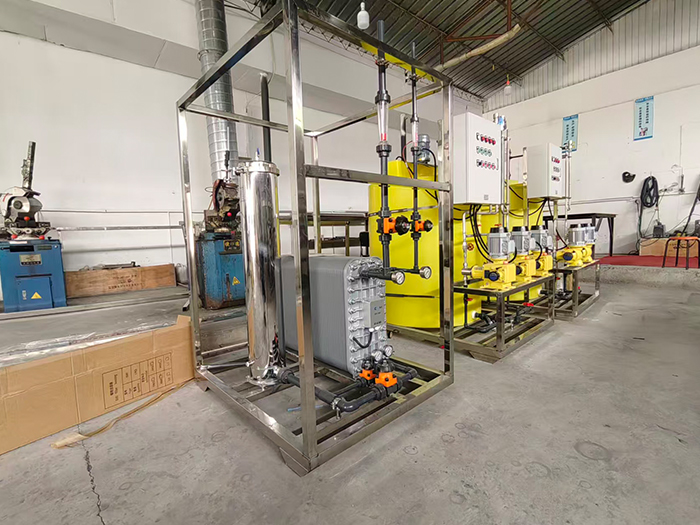
Yuan LaiEDIThe ultra-pure water equipment uses electro-deionization technology.EDIElectrodeionization is a water purification method that combines the dual advantages of electrodialysis and ion exchange. It does not require acid-base chemical regeneration and can continuously and stably prepare high-purity ultrapure water. Under the action of a direct current electric field, ion separation in water is completed. At the same time, water is electrolyzed to generate hydrogen ions and hydroxide ions, achieving automatic regeneration of the resin without the need to stop the machine for manual regeneration. The pre-treatment combined with reverse osmosis can prevent oxidized substances from damaging the resin, ensuring stable effluent quality and widely meeting the high-standard water usage requirements of various industries.
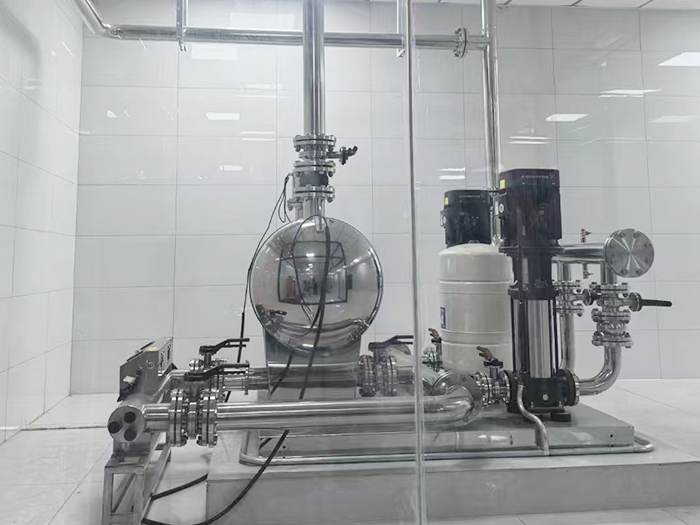
The non-negative pressure water supply equipment can be directly connected to the municipal water supply network, making full use of the residual pressure of the original network for superimposed water supply. Fully enclosed operation does not require the construction of a domestic water tank, eliminating secondary pollution. Intelligent variable frequency voltage stabilization, energy-saving, quiet and easy installation, it is the preferred equipment for secondary water supply in high-rise residential buildings and commercial buildings.
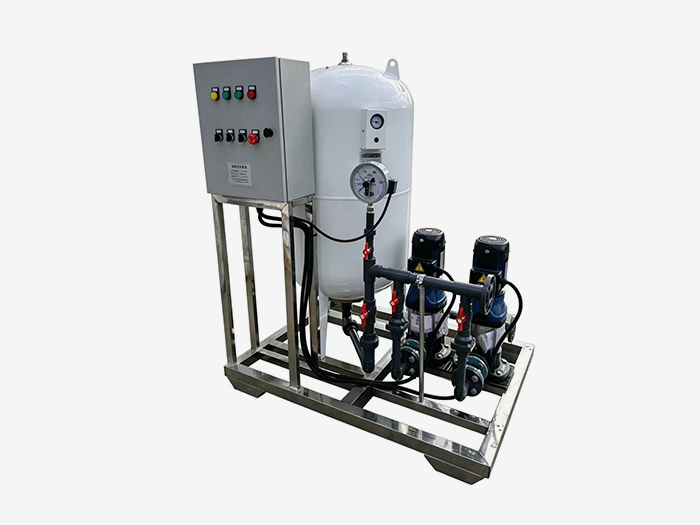
Constant pressure water supply equipment is widely used in central air conditioning, floor heating, industrial closed-loop water circulation, and boiler systems. It integrates automatic pressure stabilization, automatic water replenishment, automatic exhaust, pressure relief and buffering functions. It stabilizes the pressure in the pipeline network, eliminates abnormal sounds caused by air blockage, and prevents damage from negative pressure and water shortage in the pipeline. It is an essential supporting equipment for HVAC and circulating water systems.












 Landline:+86 010 59792055
Landline:+86 010 63780188
 Mobile:+86 13910114728
 Email:bjyuanlai@163.com
 Email:Wanda Plaza, Fengke Road, Fengtai District, BeijingBseat6Courtyard No.3Building No.7layer708
Yuanlai Homepage Softened water equipment Reverse osmosis pure water equipment Water supply equipment Engineering case Technical service Enter Yuanlai Site map
Softened water equipment Reverse osmosis pure water equipment Water purification equipment Water supply equipment Automatic dosing equipment High-purity water (ultra-pure water) equipment Wholesale of water treatment accessories
Electric power industry Petrochemical industry The electronic semiconductor industry The photovoltaic new energy industry Pharmaceuticals & Biochemical Engineering School research units Food and beverage industry Enterprises and public institutions
Reverse osmosis membrane Star-counting pump Fleck Valve Runxin Valve Instruments and meters Ultrafiltration membrane Softening resin Resin tank
