Bookmark this site Online message 中文站Welcome to the official website of Beijing Yuanlai Water Treatment Equipment Co., LTD.!
Service Hotline
+86 010 59792055 / +86 13910114728

Installation requirements and layout for water softening equipment
When installing the water softening equipment, it is essential to take into account the space reserved for the installation and commissioning of other equipment in the future. The workshop where the equipment is installed should not be too small. During the operation of the equipment, it is necessary to frequently add salt to it. Consider reserving a position for salt addition. In terms of equipment technology, it should be noted that the water softening equipment must not be installed too close to the boiler (within 4 meters). Otherwise, hot water will flow back into the water softening equipment, damaging it and causing it to be unable to operate or resulting in economic losses. The installation of water softening equipment must be placed indoors, with the indoor temperature ranging from 1 to 45 degrees Celsius. Moreover, as chemical plants contain many acidic substances or emit acidic gases, they must be kept away from these substances. In the connection of the softened water equipment pipeline, there must be drainage pipes and drainage outlets
Details >Classification of water softening devices
A water softening device, as the name suggests, is a device that softens water. Softened water has many uses. Nowadays, people are increasingly advocating the use of softened water. Whether in industry, agriculture or domestic use, softened water has played an irreplaceable role. Softened water equipment is a device that reduces water hardness, mainly removing calcium and magnesium ions from water. During the process of softening water, softened water equipment cannot reduce the total salt content in water. It can be used for softening the make-up water of air conditioning and other systems as well as for the treatment of domestic water, etc. This technology is widely applied in urban sewage treatment and water treatment equipment. The state has been constantly advocating the application of water softening equipment technology in the field of industrial wastewater. Whether a boiler can operate economically or not, water quality treatment is of great significance. If the boiler feed water is not treated or treated improperly, it is bound to be heated
Details >Raw water refers to untreated water, that is, water before it enters each process of water treatment. Softened water refers to water whose hardness (mainly referring to Ca2+ and Mg2+ in water) has been reduced to a certain extent. During the softening process of water, only the hardness is reduced, while the total salt content remains unchanged. Desalinated water refers to water from which the salt has been removed or reduced to a certain extent, with a content of no more than 1 to 5mg/L, or an electrical conductivity of 1.0 to 10.0μS/cm. Pure water refers to water from which strong and weak electrolytes (such as SiO2, CO2, etc.) have been removed or reduced to a certain extent, with a salt content of less than 1mg/L or an electrical conductivity of 0.1 to 1.0μS/cm. Ultra-pure water refers to water where almost all conductive media have been removed, and at the same time, gases, colloids, and organic substances (including) that do not dissociate have also been removed to a very low extent. The salt content in ultrapure water
Details >What are forward washing and backwashing in water treatment?
The three major contaminants of membranes and the phenomenon of concentration polarization all have a cumulative process. During the normal operation of the membrane system, regular hydraulic flushing plays an important role in reducing and alleviating membrane fouling. For medium and small-sized systems with relatively simple pretreatment processes, the effect of hydraulic flushing is particularly obvious. The normal membrane process of the so-called hydraulic Chinese and Western stop system is carried out, and a special membrane flushing procedure is performed. Hydraulic flushing can be divided into two methods: forward flushing and reverse flushing. Forward flushing (referred to as forward washing for short) is a process that uses the original liquid to wash away contaminants in a low-pressure and high-flow manner, to polarize the concentration difference, remove contaminants on the membrane surface and the filter cake layer. Reverse washing (referred to as backwashing for short) is a process that uses the permeate to flush the contaminated membrane pores at high pressure and large flow rate, thereby polarizing the concentration difference, removin
Details >Due to the retention effect of the semi-permeable membrane on solutes, a concentration gradient of solutes is formed from the membrane surface to the main body of the stock solution, that is, the phenomenon of concentration polarization is formed. Under the cross-flow operation mode, the flow state of the raw liquid in the flow channel is divided into three types. The one near the membrane surface is the laminar flow layer, the one in the middle of the flow channel is the turbulent flow layer, and the one between the remaining laminar flow layer and the turbulent flow layer is the transition layer. Driven by the pressure difference on both sides of the membrane, some of the solvent passes through the membrane to form an permeable flow, while the solute is retained and accumulates on the membrane surface. The solute concentration c in the entire flow channel varies in the vertical direction on the membrane surface. Since turbulence can effectively achieve the reverse diffusion of solutes from the membrane surface to the mainstream, the solute concentration cf in the turbulent layer can be regarded as uniform. If the solute concentration cp on the membrane permeate side is set to be
Details >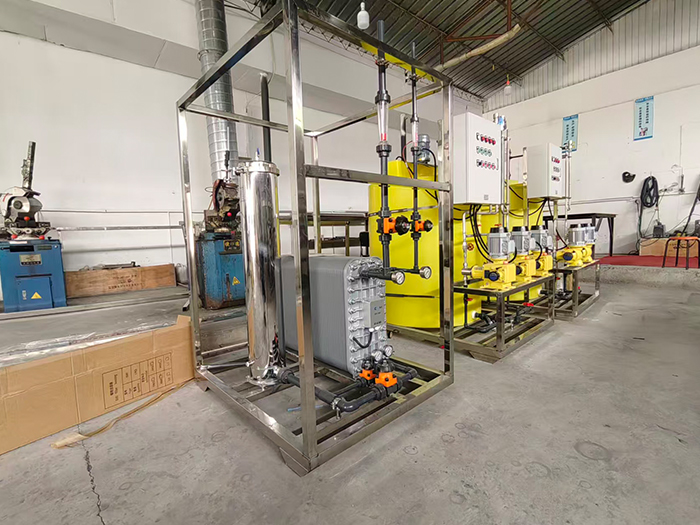
Yuan LaiEDIThe ultra-pure water equipment uses electro-deionization technology.EDIElectrodeionization is a water purification method that combines the dual advantages of electrodialysis and ion exchange. It does not require acid-base chemical regeneration and can continuously and stably prepare high-purity ultrapure water. Under the action of a direct current electric field, ion separation in water is completed. At the same time, water is electrolyzed to generate hydrogen ions and hydroxide ions, achieving automatic regeneration of the resin without the need to stop the machine for manual regeneration. The pre-treatment combined with reverse osmosis can prevent oxidized substances from damaging the resin, ensuring stable effluent quality and widely meeting the high-standard water usage requirements of various industries.
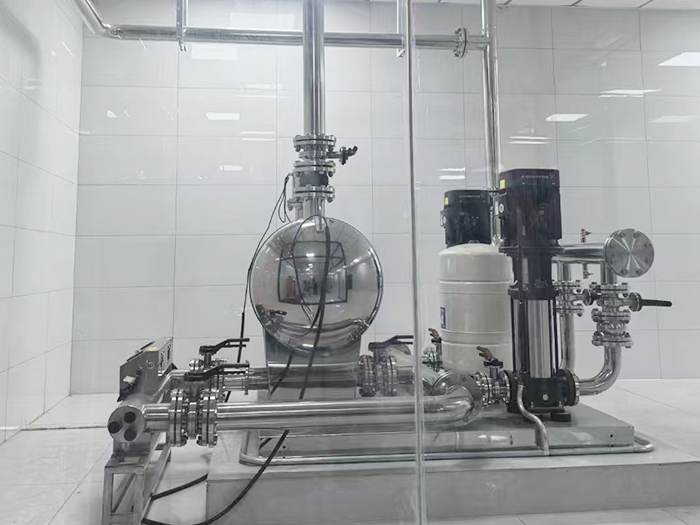
The non-negative pressure water supply equipment can be directly connected to the municipal water supply network, making full use of the residual pressure of the original network for superimposed water supply. Fully enclosed operation does not require the construction of a domestic water tank, eliminating secondary pollution. Intelligent variable frequency voltage stabilization, energy-saving, quiet and easy installation, it is the preferred equipment for secondary water supply in high-rise residential buildings and commercial buildings.
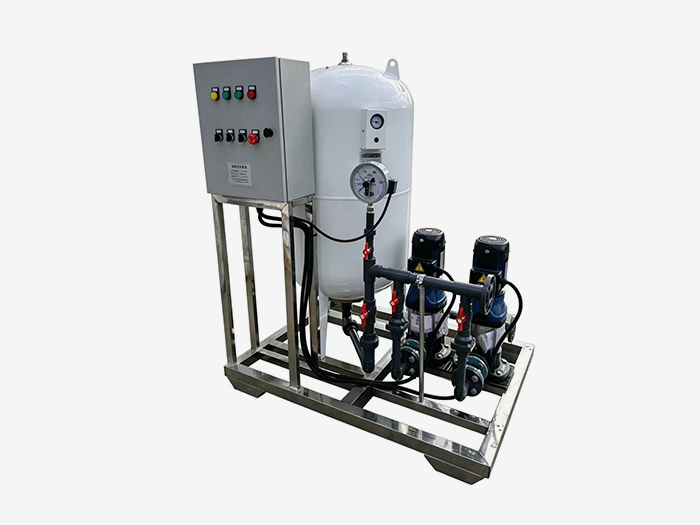
Constant pressure water supply equipment is widely used in central air conditioning, floor heating, industrial closed-loop water circulation, and boiler systems. It integrates automatic pressure stabilization, automatic water replenishment, automatic exhaust, pressure relief and buffering functions. It stabilizes the pressure in the pipeline network, eliminates abnormal sounds caused by air blockage, and prevents damage from negative pressure and water shortage in the pipeline. It is an essential supporting equipment for HVAC and circulating water systems.











 Landline:+86 010 59792055
Landline:+86 010 63780188
 Mobile:+86 13910114728
 Email:bjyuanlai@163.com
 Email:Wanda Plaza, Fengke Road, Fengtai District, BeijingBseat6Courtyard No.3Building No.7layer708
Yuanlai Homepage Softened water equipment Reverse osmosis pure water equipment Water supply equipment Engineering case Technical service Enter Yuanlai Site map
Softened water equipment Reverse osmosis pure water equipment Water purification equipment Water supply equipment Automatic dosing equipment High-purity water (ultra-pure water) equipment Wholesale of water treatment accessories
Electric power industry Petrochemical industry The electronic semiconductor industry The photovoltaic new energy industry Pharmaceuticals & Biochemical Engineering School research units Food and beverage industry Enterprises and public institutions
Reverse osmosis membrane Star-counting pump Fleck Valve Runxin Valve Instruments and meters Ultrafiltration membrane Softening resin Resin tank
