Bookmark this site Online message 中文站Welcome to the official website of Beijing Yuanlai Water Treatment Equipment Co., LTD.!
Service Hotline
+86 010 59792055 / +86 13910114728

In industries such as pharmaceuticals, electronic semiconductors, and precision manufacturing, the quality of ultrapure water directly affects product quality and production efficiency. The traditional mixed bed process was once the mainstream method for preparing ultrapure water. However, EDI ultrapure water equipment, with its own advantages, is gradually replacing the traditional mixed bed and becoming the preferred process for modern high-purity water preparation.
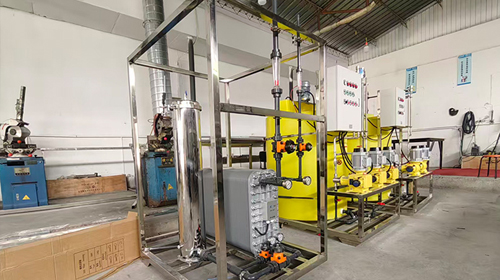
EDI (Electrodeionization), also known as continuous electro-deionization technology, scientifically integrates electrodialysis technology and ion exchange technology. Through the selective permeation of cations and anions by cation and anion membranes and the ion exchange effect of ion exchange resins on ions in water, EDI can continuously produce water No chemical agents (acids, alkalis, salts) are needed for regeneration, thus not polluting the environment. It can be fully automatically controlled. It has wide adaptability and can thus be used for water treatment in all walks of life. It has low operating costs, good economy and is easy to popularize and promote.
Overview of Laboratory High-Purity Water Equipment I. Overview of Laboratory Ultrapure Water Equipment: Laboratory ultrapure water equipment is a pure water manufacturing technology that combines ion exchange technology, ion exchange membrane technology, and ion electromigration technology. It belongs to high-tech green environmental protection technology. EDI ultra-pure water equipment has the advantages of continuous water output, no need for acid and alkali regeneration, and unattended operation. It has gradually replaced mixed beds as a fine treatment device in pure water preparation systems. This technology has good environmental protection features and is easy to operate. It is increasingly recognized by people and is being promoted more and more widely in industries such as medicine, electronics, power, and chemical engineering. Ii. Advantages of Laboratory Ultrapure Water Equipment 1. No need for acid and alkali regeneration: In mixed beds, resins need to be regenerated with chemical acids and alkalis, but EDI eliminates these harmful substances
EDI ultra-pure water treatment equipment is a pure water manufacturing technology that combines ion exchange technology, ion exchange membrane technology and ion electromigration technology. It features no need for acid or alkali regeneration. The operation is continuous and simple. With advantages such as simple installation requirements, it has gradually been applied in various industrial fields. Now let's talk about the six major factors that affect the operation of EDI ultra-pure water equipment. 1. Feed water Conductivity: When feed water is introduced, if the conductivity of the raw water rises beyond a certain range, the working zone of the membrane block moves downward, causing the regeneration zone to disappear and the working zone to penetrate. Most of the filling resin within the membrane block becomes saturated and ineffective. At the same time, the ion concentration in water increases. Under the condition that the voltage remains constant, the current increases, thereby weakening the process of ionizing water. Correspondingly, the H+ and OH- ions released from water decrease, directly leading to a deterioration in the regeneration of the resin. In this way, regarding the influent water quality











 Landline:+86 010 59792055
Landline:+86 010 63780188
 Mobile:+86 13910114728
 Email:bjyuanlai@163.com
 Email:Wanda Plaza, Fengke Road, Fengtai District, BeijingBseat6Courtyard No.3Building No.7layer708
Yuanlai Homepage Softened water equipment Reverse osmosis pure water equipment Water supply equipment Engineering case Technical service Enter Yuanlai Site map
Softened water equipment Reverse osmosis pure water equipment Water purification equipment Water supply equipment Automatic dosing equipment High-purity water (ultra-pure water) equipment Wholesale of water treatment accessories
Electric power industry Petrochemical industry The electronic semiconductor industry The photovoltaic new energy industry Pharmaceuticals & Biochemical Engineering School research units Food and beverage industry Enterprises and public institutions
Reverse osmosis membrane Star-counting pump Fleck Valve Runxin Valve Instruments and meters Ultrafiltration membrane Softening resin Resin tank
